
Only 30% of respondents had implemented an AI governance framework, according to a 2025 benchmarking survey by West Monroe involving representatives from 35 utilities and other organizations.
As DISCOMs introduce AI into maintenance planning, consumption analysis and network operations, its recommendations can influence which issues receive attention and how teams respond. For utility leaders, this raises an important question: what needs to be in place before AI-generated findings can be relied upon for operational decisions?
A utility-wide AI framework helps leaders assess which tasks are suitable for AI, what conditions must be met before deployment, and how its use should be governed. Reliable data, connected workflows and governance controls provide the foundation for making these decisions.
How Should DISCOMs Assess Data Readiness for AI?
Data readiness depends on what the utility expects AI to analyse. Before deploying an AI use case, DISCOMs need to establish whether the available data is sufficient and reliable enough to support the intended decision.
Consider deploying AI for transformer overloading analysis. If loading is estimated using consumer meter data, the utility needs to check:
- Transformer capacity details: Is the transformer's rated capacity accurate and up to date?
- Consumer meter readings: Are enough meters reporting, and do the readings cover the relevant periods?
- Consumer-to-transformer mapping: Are consumers mapped to the correct transformer, or could mapping errors distort the loading estimates?
The relationship between these inputs matters. Even with accurate meter readings, incorrect consumer-to-transformer mapping can distort estimated loading. Similarly, missing interval readings could leave periods of high demand unaccounted for.
Data readiness also needs to be assessed at the level where AI will operate. A DISCOM may have sufficient information for one division while another still has substantial gaps in network mapping or meter reporting.
Where meter readings are incomplete or consumer-to-transformer mappings are uncertain, DISCOMs should verify the loading estimates before using them to prioritize maintenance.
For a deeper discussion of connecting operational information across utility systems, see Why Utilities Need a Data Warehouse Before Embracing AI.
Matching AI Assistance to Utility Workflows
Once the data requirements are established, the next consideration is how AI should support the work performed by different utility teams. The information they need depends on the operational decision and how frequently that decision must be made.
- Consider metering operations. An engineer investigating non-communicating meters may need to establish whether communication failures are concentrated in a particular area or scattered across individual devices. The ability to ask follow-up questions about affected meters, locations and event histories can help narrow the investigation.
- Asset maintenance follows a different pattern. Engineers may need recurring assessments showing which transformers are experiencing increased loading, repeated outages or other signs of deterioration. A scheduled analysis can bring these findings together for periodic maintenance reviews.
- For revenue protection teams, the requirement may be a prioritized set of consumption anomalies, accompanied by the relevant patterns and historical comparisons. The information should help investigators identify which cases deserve closer examination.
For investigations requiring answers to specific operational questions, Conversational AI supports on-demand analysis, while Analysis Agents support recurring assessments and reporting for routine operational reviews.
Establishing Control and Accountability for Utility AI
The safeguards around AI should reflect what happens when its findings are incorrect. An inaccurate trend report used for internal analysis may send an engineer to investigate the wrong issue. A DISCOM could initially introduce such analysis within a limited pilot, allowing teams to review the results before wider deployment.
A suspected electricity theft alert carries greater consequences, as it could lead to an unnecessary consumer inspection. Here, AI can identify suspicious consumption patterns and assemble supporting information, while revenue protection personnel decide whether further investigation is justified. This reflects the principle of human augmentation explored in The Agentic DISCOM, where AI supports analysis and employees retain judgment over consequential decisions.
Beyond deciding who acts, utilities also need to examine the evidence behind AI-generated conclusions.
If AI flags recurring low-voltage conditions on a feeder, the responsible engineer needs to know which meter readings support the finding, when the events occurred, how long they lasted and how they compare with applicable voltage limits. These observations may confirm a voltage problem, while identifying its cause could require further network investigation. The distinction helps engineers separate observed conditions from AI-generated interpretations.
Governance also continues after deployment. Suppose an AI application repeatedly flags consumption anomalies that investigators later determine are normal usage. Reviewing these outcomes helps the utility identify recurring errors and determine whether the analysis needs adjustment.
The NIST AI Risk Management Framework emphasizes governance, accountability, evaluation and ongoing risk management throughout the AI lifecycle.
For DISCOM leaders, this means assigning an accountable owner to each AI application, establishing review requirements for consequential findings and ensuring recurring errors are addressed as AI becomes part of daily operations.
Also Read: Agentic AI in Utilities: From AMI Dashboards to Grid Governance : Grid
Putting AI Governance into Practice with WorkOnGrid Applied AI Catalogs
DISCOMs maintain extensive operational information, from smart meter readings and outage records to consumer details and asset reports. However, an AI agent investigating a specific issue may only need a selected set of these resources. Referencing unrelated reports can introduce unnecessary information into the analysis.
Let’s say for example a DISCOM reviewing its outage reliability performance. The utility wants to identify feeders contributing to high interruption duration and frequency. For this investigation, the agent may need outage-event worksheets, restoration records and reports tracking the System Average Interruption Duration Index (SAIDI) and System Average Interruption Frequency Index (SAIFI).
Consumer billing reports or unrelated maintenance records have no role in this analysis.
WorkOnGrid Applied AI addresses this through Catalogs. An administrator can create a Catalog containing the worksheets and reports relevant to the investigation. When interacting with AI within that Catalog, the agent uses only the selected resources as references.
Applying and Testing Catalogs in an Outage Investigation
Using the Outage Reliability Review Catalog, a utility administrator could ask: "Which feeders contributed most to interruption duration during September, based on the selected outage records?"
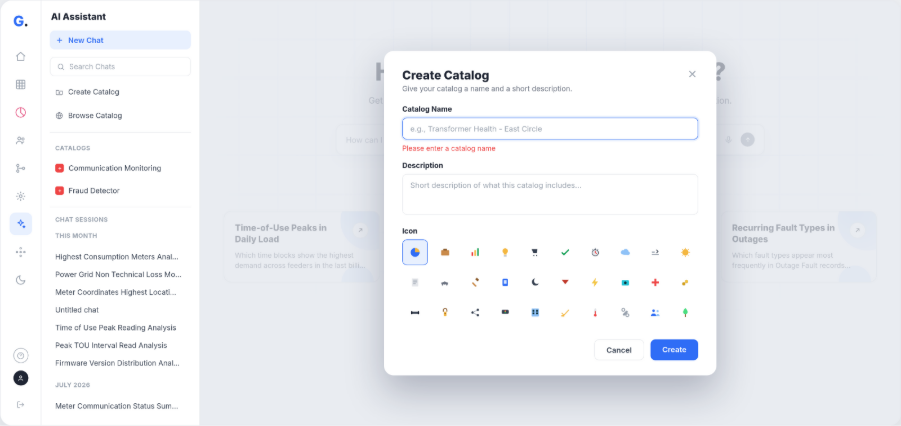
The agent analyses the worksheets and reports available within the Catalog. If the investigation requires another report, the administrator can add it to the selected resources.
As operational reporting changes, the Catalog may need updating to include new approved worksheets or replace outdated reports.
Catalogs control which information an AI agent can reference. User permissions, approval of operational actions and verification of AI-generated conclusions remain separate governance responsibilities.
Building an AI Framework That Utilities Can Govern
For DISCOMs, a practical starting point is to select an AI use case, establish the required data and operational purpose, and define the controls governing its use.
WorkOnGrid Applied AI Catalogs provide one such control by allowing utilities to restrict the worksheets and reports an agent reference. Combined with appropriate human oversight, clearly defined information boundaries help utilities maintain control as AI becomes part of everyday operations.
Talk to our team to explore how WorkOnGrid Applied AI can support your utility's AI adoption.

-compresso.webp)