

Most conversations I hear about AI in utilities still revolve around automation, autonomous operations and how these changes will affect the people doing the work today.
But there is one more useful question for utilities: how much more capable can AI make the people already running the grid?
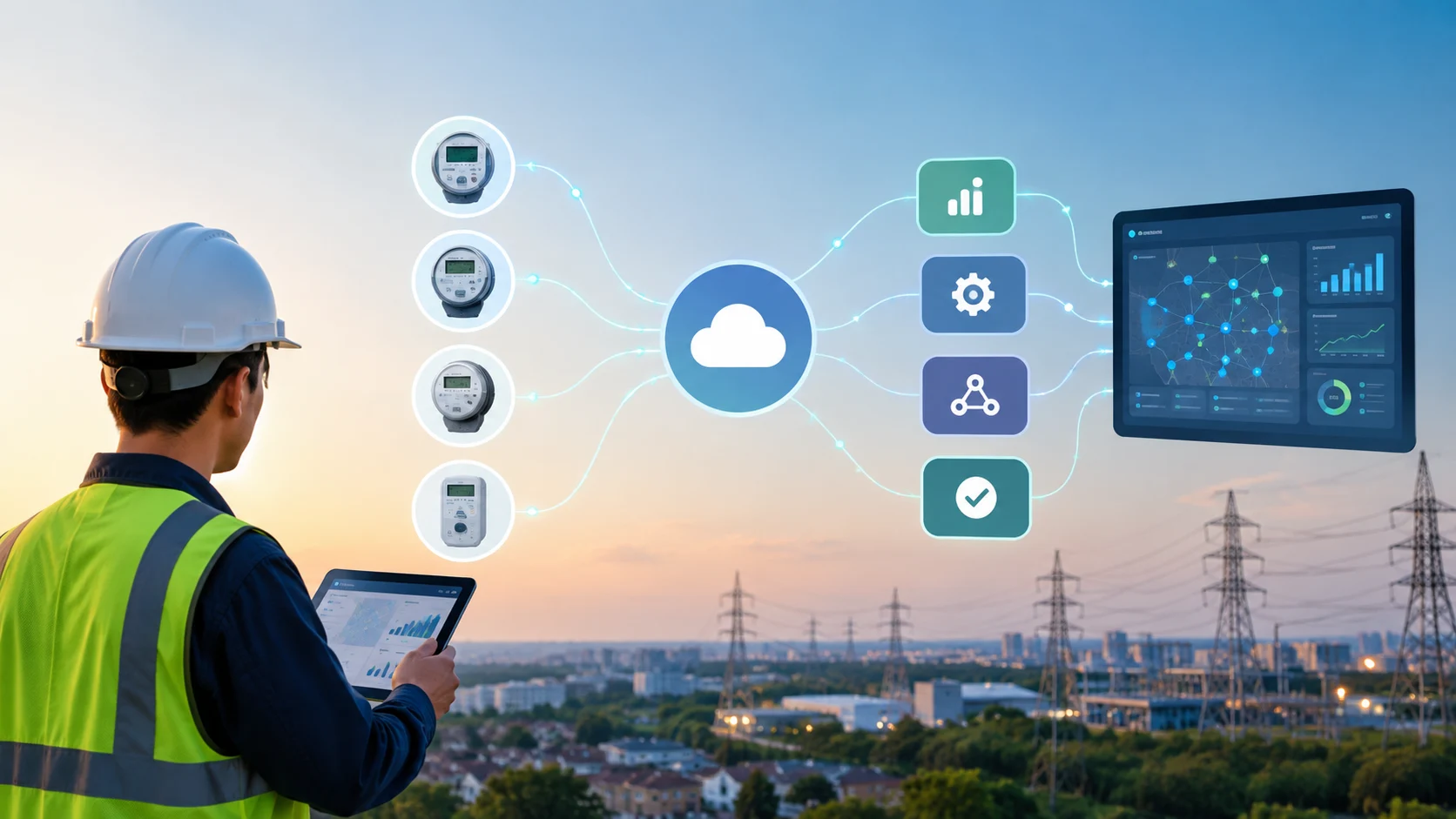
Utilities already have smart meters, outage systems, billing platforms and other systems producing huge volumes of data. The challenge is that someone still has to make sense of what matters, pull the right context together and decide what should happen next.
An Agentic DISCOM changes how that work gets done. It puts augmented people at the centre, with agents taking on more of the watching, sorting and preparation around the work, while human judgment stays where it matters.
Analytics tells you where to look. What happens next?
For years, utilities have used analytics to make sense of growing volumes of smart meter data. A model can flag a customer for possible theft. A dashboard can show feeder losses. A monthly report can highlight a spike in unbilled energy, repeated meter tamper events or an unusual consumption pattern.
These tools help narrow down where to look. However, the operator still needs to pull the relevant records, understand the context, decide whether the case holds up and prepare a field inspection, billing review or customer notice.
This is where the role of an AI agent becomes clearer.
Give an agent a goal, such as reducing unbilled energy, and it can keep working towards that goal as new data comes in. It can pull billing records, check asset history, prepare a work order and bring the relevant information together for the person who owns the decision.
The decision itself still needs context and judgment. Is a strange power spike deliberate theft, or is it a faulty meter? Should a struggling family be disconnected, or offered a payment plan? Those decisions carry legal, social and safety consequences.
That is also what a non-technical loss detection team in Naturgy’s Spanish operations found: leaving out the human factor could put model performance at risk when shifts in the data or hidden biases were difficult for the algorithm to catch on its own.
Where agents start proving their value
Once you look at the day-to-day work inside a DISCOM, the agent use cases become much more practical.
I see them showing up in 4 main areas.
- Protect revenue. Agents can spot theft, catch billing errors, support collections and help trace where energy is going missing. In one study, a machine-learning model showed the capability to improve a utility’s inspection hit rate from 3% to 60% compared to the earlier manual approach.
- Optimise costs. Agents can forecast demand, support power-procurement decisions and monitor asset health so utilities can plan maintenance and replacement earlier.
- Create revenue. Agents can help utilities find spare network capacity for new demand such as data centres, EV fleets and electrified industry. They can also identify retention and electrification opportunities and help coordinate distributed flexibility. The US Department of Energy estimates that scaling virtual power plants to 80–160 GW by 2030 could save around $10 billion a year in grid costs.
- Run the grid. Agents can manage changing conditions across solar, storage, EVs and flexible loads by forecasting congestion and ranking possible responses. UK Power Networks expects flexibility to reduce load-related spending by up to £410 million over its current regulatory period.
That matters because the value of flexibility depends on being able to coordinate thousands of distributed resources in real time. Trying to pool home batteries and EVs to avoid a sudden grid peak is extremely difficult for a human operator to manage manually.
An AI agent can sort through those options and put the most relevant response in front of the operator.
What changes when every utility worker gets more reach
AI agents transform the daily on-the-ground lives of utility professionals. How? Let’s consider a few everyday roles of a utility operator.
A field inspector can spend too much time on scheduled inspections or cases where the team has only a weak indication that something is wrong. In an Agentic DISCOM, they start with higher-confidence cases where meter events, billing history and other digital evidence have already been pulled together.
A network engineer may only get a clear signal once an asset is already under stress or service has started to suffer. An agent can flag abnormal loading, repeated outages or other early warning signs, giving the engineer more time to intervene before the issue becomes a failure.
A control-room operator has a different problem: too many live conditions changing at once. When congestion starts building, an agent can surface the constraint early and rank possible responses such as flexibility, switching or curtailment, so the operator can decide what to do next.
For every young worker entering a grid-related job, 1.4 workers are nearing retirement, taking years of operational judgment with them.
When a veteran engineer looks at an agent’s suggestion and says, “That pattern points to a faulty Current Transformer, not theft,” that correction can help the agent handle similar cases better and pass that judgment on to newer colleagues.
Trust has to grow before autonomy does
You do not wake up one morning with a fully agentic utility. It has to earn its way into your operations.
- It starts with narrow assistance, where agents help with specific tasks under close human supervision.
- As teams see where the recommendations hold up, agents can take on more, triggering workflows and preparing actions while people still approve the consequential steps.
- Only later do you get to a more orchestrated utility, where agents coordinate across functions such as procurement, flexibility, forecasting or dispatch. Even there, people still set the goals, policies and limits around what those agents can do.
Across the industry, I see this progression playing out in three broad horizons, even though the exact timing will vary by utility and region.
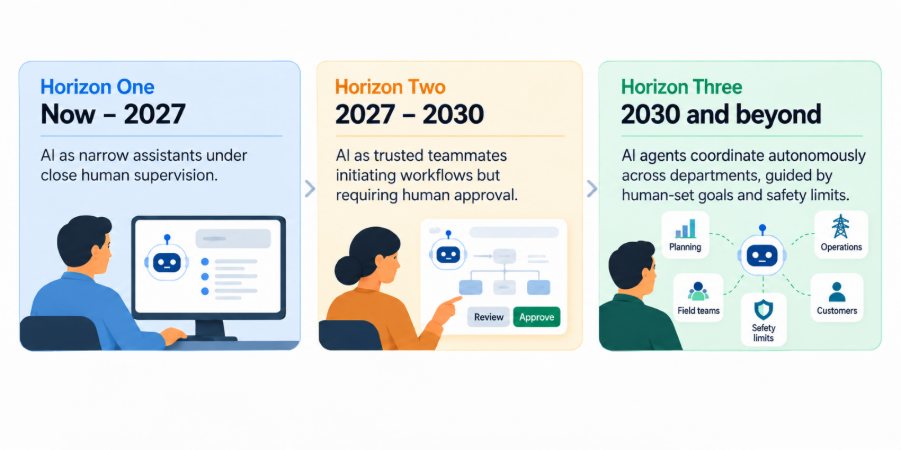
To earn that kind of trust, clear guardrails need to be in place: people should be able to see why an agent made a recommendation, challenge it when necessary, and know that customer data and consequential decisions remain properly protected.
Build the Agentic DISCOM one step at a time
For the utilities starting today, the roadmap can stay simple.
- Pick one problem with a clear price tag, such as losses on a specific feeder.
- Fix the data needed for that problem.
- Put the people who do the everyday work in the room to help design how the agent supports them.
- Start the AI in suggestion mode. Let it prepare the case before it is allowed to take routine actions.
- Buy outcomes from vendors where possible, rather than measuring success by software licences alone.
The grid will only get more complex from here. The real opportunity is to give the people already running it more reach, better support and more time for the decisions that still need human judgment.

.png)
.png)


