
.jpg)
Why is visibility alone no longer enough in Modern AMI networks?
Most utilities today probably already have solutions for AMI dashboards, interval reads, alarms, and event feeds. But the real challenge is deciding what actions to take after a signal appears. For example, as seen with one of Grid’s customers, where a utility manages 400,000 smart meters and up to 19 million data points in a single day, a dashboard would not be enough. It can highlight issues, but it cannot decide which SLA breach needs immediate attention, which communication issue is spreading, or which field team should act on it.
Such operational gaps slow response times, increase billing risk, and extend service issues. Also, small events or exceptions can quickly turn into larger operational or revenue losses. The real constraint in AMI utility management is not just limited to gaining end-to-end visibility, but to not having frameworks or solutions for real-time, scalable follow-through.
This is where Agentic AI becomes a relevant solution for utilities, enabling operators and decision-makers to continuously monitor grid conditions, interpret operational context, and support risk management. And all of this is achieved while maintaining compliance with updated governance and regulatory laws.
What does Agentic AI mean in utility operations?
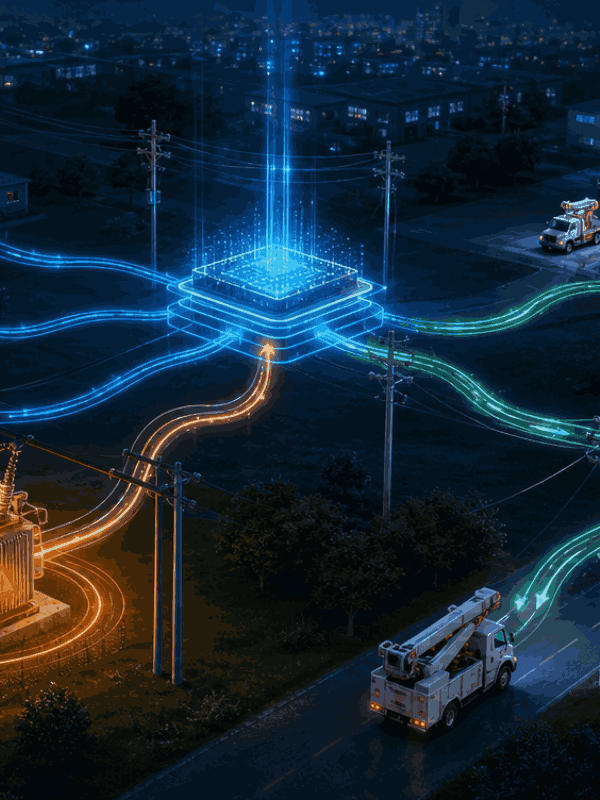
Agentic AI in utilities does not limit itself to a chatbot or a reporting layer. It is better understood as an autonomous decision layer that sits on top of existing utility data and workflows. The autonomous agent is designed to continuously watch grid conditions, understand each event within a defined context, and help trigger the next step without forcing teams to jump across systems.
For instance, Grid AI is designed with a framework that best describes this shift to smarter utility operations: ask, analyze, and act. This turns AI into more than just a tool for answering chatbot queries. AI becomes a real-time operational participant in monitoring, prioritizing, and supporting real-time informed decision-making.
Understanding what Agentic AI is only sets the foundation. Here, the bigger question is: what actually changes inside utility operations once AMI data begins flowing at scale?
How does Agentic AI function as an autonomous workforce for real-time monitoring and decision making?
The operational signals generated by modern AMI networks are far more voluminous than any human team can manually handle. Communication failures, consumption anomalies, metering events, SLA breaches, outage indicators, field exceptions and more can appear across the network at the same time. While gaining visibility into every issue is important, the real challenge is deciding which one needs immediate attention.
In such ecosystems, Agentic AI works as an autonomous workforce by continuously watching every signal, filtering high-priority events, and identifying patterns that may link to a specific cause. Utility Management solutions like Grid AI can also recommend the next best step and trigger a defined action path, allowing utilities to reduce the time between detection and response.
Consider a scenario where a dashboard highlights a group of meters within a zone as non-communicating. The report only shows that data from those meters is missing. However, an Agentic AI layer goes one step further by checking whether the issue is isolated or systemic, linked to a wider cause, or a field-level equipment problem.
Here, the value of Agentic AI is not workforce replacement but workforce expansion. Such capabilities give utility teams wider monitoring coverage, more consistent decision support at a faster speed and provides true operational intelligence.
How does Agentic AI enable utilities to move from dashboards to governed actions?
Dashboards are useful because they help utilities see what is happening across the network. They can show missing reads, communication issues, outage indicators, or rising exception volumes. But dashboards are still passive. They depend on human intervention to make sense of a signal, decide what matters most, and determine the next course of action.
That is where agentic AI changes the model. It goes beyond grid visibility, empowering utilities to move from:
Event visibility to event prioritization
Now, instead of just highlighting an event, an agentic AI solution evaluates the context, checks its likely impact, and ranks it against other issues across the network. This helps utilities identify which events need immediate attention and which can be monitored or resolved later.
Alert overload to decision intelligence
Instead of passing every alert to all operators, agentic AI filters repetitive or low-value signals. It then connects related exceptions and highlights the few that require action. This gives teams clearer guidance on what is happening and what decision should follow.
Static reporting to operational follow-through
Standard utility reporting records what has already happened. AI-enabled reporting extends that process by linking an event signal to the next step, whether that means escalation, investigation, field action, or further validation. This framework ensures that the workflow does not stop at observation.
This difference is crucial for utility executives to understand. The real value here is not just enhanced observation, but turning those observations into governed actions across workflows.
How can Agentic AI strengthen utility grid governance?
AMI governance is not limited to monitoring utility assets. It also involves determining which ones deserve attention, who should respond, what workflows can be automated, and where human approval is required to stay in the loop. In hindsight, it is about making informed decisions so that events are detected early and do not translate into public failure.
The Texas power crisis of 2021 due to storms is a stark reminder of such events. Overall, it resulted in 246 confirmed deaths, and later reviews found that more than 61,000 MV of generation became unavailable during the outage. The total damage estimates during the storm ran to over $300 Billion.
Why this example becomes so important is because it shows what governance failure looks like in practice. During unprecedented weather events like storms, governance unpreparedness can often lead to:
- Delayed event preparation (late readiness planning for storms, outages, or sudden load stress)
- Weak forecasting (poor prediction of weather impact, load shifts, or unit availability)
- Limited staging (insufficient pre-positioning of crews, equipment, and materials before conditions worsen)
- Slower response times (longer delays in dispatch, investigation, and corrective action after an issue is detected)
So, how does Agentic AI solve utility governance challenges?
Agentic AI continuously analyzes data 24x7 throughout the network, identifies load patterns early on, helps operators match available energy supply & demand for streamlined energy monitoring. At a minute-by-minute level, such granular data visibility allows control rooms to:
- Stage reserves sooner (prepare backup power, standby capacity, or response resources in advance)
- Prioritize field actions faster (decide which crew tasks, locations, or equipment issues need attention first)
- Avoid delayed intervention (reduce the risk of acting too late on outages, failures, or rising grid stress)
For modern utilities, robust governance also means staying in line with broader frameworks and norms. Some key governance frameworks for smart utility metering include:
- ISO 50001 for energy performance management
- ISO 55001 for focus on disciplined asset management
- NERC/FERC reliability standards for documented and defensible grid decisions
As the next frontier for utility grid governance, AI platforms like Grid are not just about greater visibility, but about unlocking intelligent and accountable decision-making at AMI operational scale.
What is the cost for utilities when governance or compliance is missed?
The real cost of not meeting governance requirements is not limited to a penalty. It can also severely affect decision-making, reduce trust in data, increase rework, and create avoidable pressure on service reliability, revenue, audit readiness, and more. In smart metering networks, the risk increases because teams already have to deal with constant streams of data, alarms, and exceptions. With weak governance, more data does not lead to more control. Instead, it creates more confusion, delay, and untraceable action.
Let’s consider a real-life example of AEP (American Electric Power). In 2010, the energy grid experienced several outages on its 138 kV system. Here, investigators revealed that rules for communication and operating response were not clear and direct during the event. It resulted in 10 reliability violations and an aggregate fine of $225,000. Moreover, many of these violations were assessed as serious to substantial risks to bulk-power system reliability. This was due to unclear directions during events and outages, which often delay the right course of action when timing matters most.
The lesson for modern utilities here is understanding the substantial damage that can happen from not meeting compliance requirements.
- Audit burden (more time, cost, and internal effort spent proving that decisions, actions, and controls were properly followed)
- Service failures (slower response, unresolved outages, or poor operational follow-through that can affect reliability and customer experience)
- Billing disputes (higher chances of incorrect bills, delayed corrections, and added pressure on revenue recovery and customer support teams)
- Reputational damage (loss of trust among customers, regulators, and stakeholders, which can weaken public confidence in utility operations)
Now, simply investing in AI platforms or co-pilots for automation might not make things better. If the solution does not understand the context and the governance requirements within it, the lack of oversight can make the situation worse.
This is where solutions like GridAI become truly relevant. It is not just a generic co-pilot but a well-versed utility SME agent. One that is domain-trained to understand user inputs or prompts in smart metering, WFM, and SMOC patterns. This ensures that all outputs are aligned within the operational context and help deliver tangible results instead of suggestions.
Conclusion
Utilities already know how to collect and visualize AMI data. The next frontier is turning that data into faster, more consistent action by enabling AI to function as an autonomous workforce for monitoring and decision support. This shift matters because dashboards alone cannot keep pace with the volume, speed, and complexity of modern AMI utility operations.
At the same time, utility leaders must also understand that the strongest future model is neither human-only monitoring nor uncontrolled AI automation. It is AI-led operations monitoring with governed human supervision, where routine signals are handled faster, priorities are clearer, and every action stays aligned with operational and compliance needs.
For forward-looking utilities, this creates broader organizational value: stronger operational control, faster response, lower avoidable losses, better workforce productivity, and more confidence in decision-making at scale. If you’re wondering what this could look like, connect with our team to understand how Grid AI could be deployed within your utility environment.

.png)
.png)


