
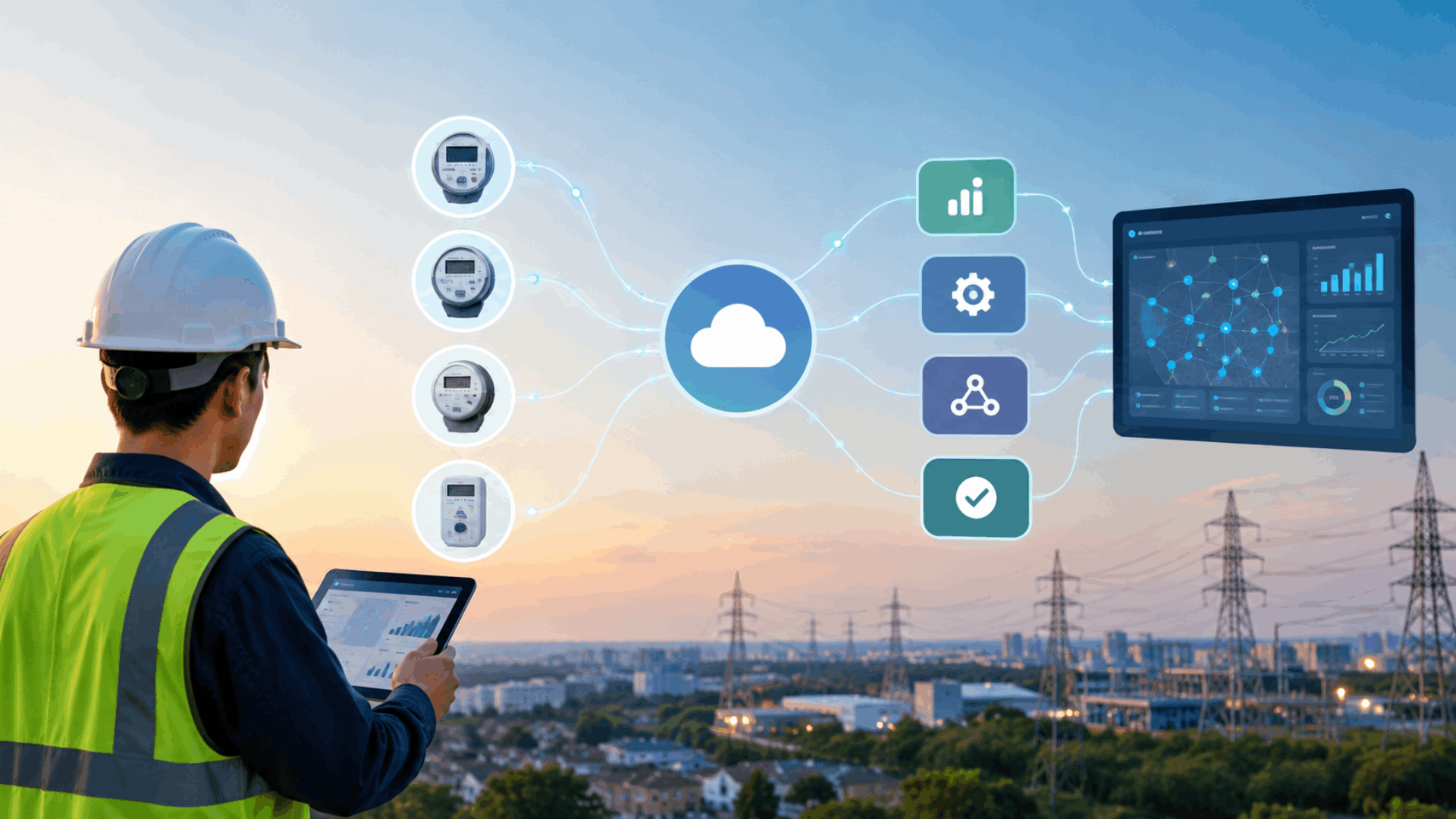
Over the last few months of my interactions with utilities across India, the Middle East, Europe and Asia and my conversations with industry leaders about smart meter rollouts, one learning has consistently stood out to me.
A lot of smart metering conversation still centers on deployment. How many meters have been installed? Are they communicating? Is the data reaching HES, MDM and billing?
But once the meters are deployed, a harder operational question appears, which is: how do you make all these processes work together day after day, at scale?
And that, I believe, is what utilities now need to plan for: an operational layer that sits above HES, MDM, billing, DERMS and other systems, understands what is happening across them, reconciles where things don’t match, and coordinates what should happen next.
Here are a few things I noticed as the rollouts scaled, along with my two cents on what it takes to operate smart metering at scale.
Scale changes everything
To help you get a sense of the volume we are talking about, there were around 1.42 billion smart electricity meter connections deployed worldwide in 2025. At that scale, a utility may already be dealing with multiple meter vendors, different communication technologies and networks, several HES platforms, MDM and billing systems, external platforms and different business rules, all operating at the same time.
And this is something I have seen come up repeatedly in conversations: each of those systems works well on its own, but as things scale up, much bigger problems start to emerge, like: Is the data reaching the right system? Is there a delay? Does the MDM reflect the same state as the HES? Is billing operating on the information that was actually collected? If a request is received from an external platform, where should it go and how should it be processed?
That is what scale really changes. At that point, the real struggle is about keeping data, requests and systems aligned across multiple platforms, and knowing exactly where something has been delayed, stopped or gone out of sync.
Making sense of the signals
So, what actually happens when all these scaled up systems start talking at once? (Let’s say 1.42 billion meters send one interval reading every 30 minutes; then they would generate more than 68 billion readings in a day) and those readings will consist of not just consumption data but also, tamper alerts, voltage fluctuation flags, communication failure logs and other operational signals that each meter generates.
Under normal circumstances, the operations team will have to investigate each issue system by system, silo by silo, to understand where the problem sits. If a meter stops responding, is the problem in the communication network? Or the HES? Or somewhere further downstream?
When you have a consolidated operational view, those isolated events start revealing crucial intelligence about the health of the AMI network (because the operators will get all details of where an issue is and why it may be happening)
Visibility versus reconciliation
The most important learning that became obvious during my interactions was that these operational gaps are being caused by data being dropped between disconnected systems.
The data points originate at the smart meter, pass through the communication network, get caught by the HES, are handed off to the meter data management system, and then go to billing.
At every single stage of this data pass, there is a very real possibility of a delay or mismatch. The meter might have communicated perfectly, but the data just did not make it downstream. So, you need clear visibility into what each system is showing, and there must be a reconciliation step, to check whether the same event has carried through correctly across them.
This is where SMOC comes into play by giving the utility an operational layer that helps teams identify where information is delayed or missing.
What is the main objective of SMOC?
Imagine what happens if your head-end system shows a meter as active and communicating, with zero problems, but your MDM shows missing data because of a disconnect in the flow. As a result, your billing system, completely unaware of what the HES is saying, relies on outdated estimated readings, and that leads to real, tangible revenue loss for the utility.
This is exactly the sort of problem a SMOC is meant to solve. It points to the most critical questions: Does the HES agree with the MDM? Is the billing system actually operating on the information the HES collected? A SMOC does not just show what each system is reporting, but it reconciles those views to identify where the data or process stopped matching across HES, MDM, billing and other systems.
Orchestrating the future grid
One recurring operational challenge of utility leaders raised in these conversations was what happens after an RC/DC or on-demand read (ODR) request comes in from an external platform. When you are operating millions of meters across multiple HES platforms, utility teams cannot manually follow every request to figure out where it should go and whether it was eventually completed or not.
This is where SMOC moves beyond monitoring; actual orchestration happens here, where your operational layer must automatically evaluate and route the requests to the correct HES or MDM against predefined business rules. It has to monitor whether the process was completed successfully. So, every request is accounted for at the backend. If one gets delayed, fails or does not go through as expected, that exception needs to be flagged back to the team.
The intersection of smart metering and grid operations
The smart meter is no longer a stand-alone consumer-end tool. It is creating intelligence at the edge of the grid, and that intelligence needs to be connected with what is happening across the wider distribution network.
Take rooftop solar. At one point, a consumer is drawing electricity from the grid, and at another, sending power back into it. The meter can track what is happening at that point. But to understand the wider impact, the utility needs the network context from systems such as DMS (Distribution Management Systems).
So, meter data gives you the local picture, while DMS gives you a wider network picture. SMOC, on the other hand, can help bring those two views together, providing a consolidated operational view so teams can understand how changes on the network are affecting meters, see the impact of distributed resources at the meter level, and coordinate the processes that need to follow. As the grid becomes more dynamic, meter operations and grid operations need to be looked at together.
What I have taken away from these conversations is that the next phase of smart metering will not be defined by deployment alone. As smart meter rollouts grow larger and more interconnected, the ability to reconcile what is happening across systems and orchestrate what needs to happen next will become just as important as getting the meters into the field.

.png)
.png)
.jpg)


