Key Takeaways
- 7.24 crore smart meters are installed against 20.33 crore sanctioned under RDSS, shifting the focus from deployment to measurable results.
- The rollout gap is largely operational, with tendering, contracting, PPP execution and consumer engagement among the cited challenges.
- The real gains are downstream: better billing accuracy, stronger collections and more effective energy accounting.
- Those gains depend on meter data reaching billing, energy accounting and network analysis so DISCOMs can identify losses and act on them.
- As deployment scales, data integration becomes critical: the question is whether DISCOMs can turn meter data into faster decisions and measurable financial results.
Where the rollout stands
Minister of State for Power Shripad Naik informed Parliament that 7.24 crore smart meters, covering consumer, distribution transformer (DT) and feeder meters, were installed nationally as of 30 June 2026. Of those, 5.73 crore fall under RDSS (Revamped Distribution Sector Scheme), with the balance coming through other initiatives including the National Smart Grid Mission.
Sanctioned volume under the scheme is 20.33 crore meters out of which:
- 19.79 crore consumer meters
- 52.53 lakh DT meters
- 2.05 lakh feeder meters.
The sunset date stands at 31 March 2028. The deployment is large. Where it has run behind schedule, the reasons are procedural rather than technical.
What the Ministry says slowed the rollout
Parliament was told the rollout has run slower than targeted. Five reasons were cited, and they sit at the front end of the process rather than in the field:
- Initial delays in issuing the model Request for Proposal (RFP), establishing the test bed and empanelling vendors.
- Delay in tendering and awarding works, with some utilities needing longer for board approval and tender issuance.
- Delay in signing contracts and Direct Debit Facility agreements.
- Difficulty implementing in PPP mode.
- Inadequate consumer engagement.
Not one item on that list is a meter, a communication module or a head-end.
That matters because it tells a DISCOM where the risk actually sits. A tender bottleneck can be re-sequenced. Building the skills to run a data estate takes longer, and the scheme's own capacity-building numbers are moving slowly: of ₹100.9 crore allocated for training and capacity building of distribution company personnel in digital systems, ₹23.36 crore had been used till July 2026, with 14,853 personnel trained.
Where the sanctioned money actually sits?
The figures below are from the Ministry of Power's reply in the Rajya Sabha on 10 August 2026, covering works sanctioned across 28 states and 45 distribution utilities.
.png)
Of the amounts sanctioned, ₹47,124 crore has been released since FY2023, including ₹2,733 crore towards smart metering works.
The digital systems line is where a meter read becomes a bill, a loss statement and a work order. At current sanctions it is 3% of the metering outlay.
That ratio is not by itself a criticism, because meters are capital-heavy and software is not. It becomes a problem when a utility treats the smaller line as an accessory to the larger one rather than as the mechanism that makes the larger one pay.
The Ministry has also initiated the India Energy Stack, intended as a common digital framework for data exchange across the country's power sector, which points the same way.
Where the chain between the meter and the bill breaks
Better billing accuracy, stronger collections and usable energy accounting come from what happens to meter data after the read, not from the meter itself. That makes the communications, data and software connecting meters to utility operations critical.
A meter is only the first step. Its read has to reach billing on time, moving from the head-end through meter data management. It has to be validated and tied to the right consumer, the right DT and the right feeder, because DT input can only be compared against summed consumer consumption once those associations are correct. Exceptions then need to reach field teams, and the results have to be measured.
If any link breaks, meters can keep reporting without improving billing or collections.
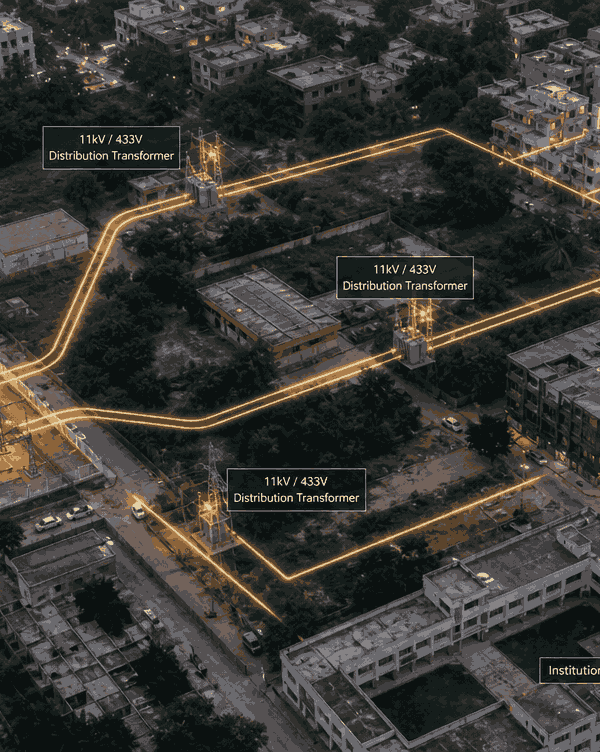
The sanctioned mix reflects this dependency. The 52.53 lakh DT meters and 2.05 lakh feeder meters enable consumption to be reconciled against network input. Without this system-metering layer, a large consumer-meter rollout can generate plenty of data without delivering enough insight.
Six operational questions DISCOM should be asking
For a DISCOM assessing whether its metering investment is converting, the useful review is not the installation dashboard:
- What is the read success rate this month, and what share of those reads were backfilled rather than received on time?
- What percentage of consumers are billed on actual meter data rather than estimated reads?
- What share of consumers are correctly mapped to their DT and feeder in the billing master?
- How many days after period close can a feeder and DT level loss statement be published?
- How long does an exception take to become a verified field inspection?
- Do AMISP payment milestones depend on data availability and quality, or only on meters installed and commissioned?
A utility that cannot answer these does not have a metering problem. It has a reporting chain that stops at the meter.
What has to change before the March 2028 Sunset
The Ministry has built an oversight structure around the tendering and contracting delays:
- Works are monitored through Power Finance Corporation (PFC) and REC Limited as nodal agencies.
- An Inter-Ministerial Monitoring Committee headed by the Secretary (Power) tracks progress centrally.
- State-level Distribution Reforms Committees, chaired by the respective Chief Secretary, oversee implementation.
- Regular review meetings run with states, distribution utilities and Advanced Metering Infrastructure Service Providers (AMISPs).
- Consumer-facing measures include bill rebates for prepaid installation, no penalty based on maximum demand recorded by smart meters, recovery of past arrears in easy instalments, and check meters to improve confidence in meter accuracy.
Billing accuracy, collections and energy accounting move only once the reads are reconciled and acted on. Closing that gap is an operational intelligence problem rather than a procurement one. It needs the layer above the meters running continuously:
- reconciliation that produces a defensible monthly energy accounting statement
- checks that separate a real commercial loss from a metering error before a crew is dispatched
- verification that a control action changed the supply state rather than that a command was acknowledged
This is where WorkOnGrid focuses. Grid runs on top of the head-end system, meter data management, customer information system, SCADA, geographic information system and billing platforms a utility already operates, through API, file or database connectors, usually with no new metering hardware. It adds the live operational layer, the analytics, the automations and the agentic AI above them.
Utilities evaluating that layer should require it to be proved on their own estate, on their own reads, through a well-structured pilot program. What separates the two halves of this programme is control. How fast the meters go in depends on AMISPs, state approvals and consumers. What happens to the data once it arrives sits largely within the DISCOM's own control, and that is the half the scheme will be judged on.
Installation figures will keep being reported through to March 2028. The numbers worth watching are the ones that come after the read!