Key takeaways
- DERC rejected BEE’s ₹12.54 crore penalty claim but gave NDMC 90 days to clear its pending periodic energy accounting reports and establish the required centralised cell.
- BEE said only two of 14 periodic energy accounting reports had been submitted.
- NDMC cited administrative difficulties and a financial and accounting setup based on an annual cycle as challenges in meeting the requirements.
The Delhi Electricity Regulatory Commission (DERC) has given the New Delhi Municipal Council (NDMC) 90 days to operationalise a centralised energy accounting and audit cell and submit its pending quarterly energy accounting reports. NDMC also has 120 days to complete the outstanding annual energy audit reports for FY2023-24 and FY2024-25.
DERC has treated this as one-time relief. If NDMC misses the new deadlines, the Bureau of Energy Efficiency (BEE) can initiate fresh proceedings. BEE is a statutory body under the Ministry of Power, Government of India, set up under the Energy Conservation Act to promote and oversee energy-efficiency requirements. BEE brought the non-compliance case, while DERC, Delhi’s electricity regulator, reviewed it and issued the order.
For other DISCOMs, the more useful part of the case is why NDMC fell behind. According to BEE, only two of the 14 periodic energy accounting reports due had been submitted. NDMC told the Commission that meeting BEE’s quarterly reporting requirement was difficult because its financial and accounting systems were tied to the municipal treasury and operated on an annual accounting cycle.
The wider operational question this situation brings up is: can a DISCOM produce a current energy account when it is required, or does the data have to be assembled every time a quarterly report is due?
NDMC’s Reporting Record Shows the Scale of the Compliance Gap
Of the 14 periodic energy accounting reports NDMC owed under BEE's 2021 regulations, only two (Q2 and Q3 of FY2023-24) had been submitted, despite repeated notices. Its annual audits were delayed too: reports for FY2020-21 and FY2021-22 arrived only in February 2024, followed by FY2022-23 in March.
NDMC argued that its status as a statutory municipal body and deemed distribution licensee placed it outside the requirements being applied to regular distribution licensees.
DERC held that NDMC was covered by the Energy Conservation Act. The Commission pointed to the scale of its distribution operations, which were around 1.36 billion units handled in FY2024-25 and 1.32 billion units in FY2023-24.
However, the Commission still chose to waive the penalty on this occasion, saying compliance and lower energy losses would better serve the purpose of the law than transferring money between two public authorities. It also made the financial responsibility for any future penalty clear: NDMC would have to bear it from its own resources, without passing the cost through its aggregate revenue requirement, true-up, tariff filings or consumers.
What other DISCOMs can take from NDMC’s explanation
NDMC’s explanation shows why periodic energy accounting can become difficult when the systems behind it are not built in a way that allows for flexibility in the reporting frequency and period. NDMC cited both administrative hurdles in setting up the required cell and a financial system that ran on an annual cycle, which clashed with BEE’s quarterly energy accounting requirements.
For other DISCOMs, the lesson is that energy accounting needs clear ownership across the teams involved. When finance, IT and energy-accounting responsibilities sit in separate processes, reporting can get delayed even when the underlying data exists.
A defined process helps each team know what data is needed, who is responsible for it and when it has to be ready, so quarterly reporting does not depend on ad hoc coordination.
The solution requires accurate, up-to-date consumer indexing
BEE defines energy accounting as accounting for energy entering the distribution network at different voltage levels and the energy ultimately consumed by end consumers. It also links the exercise directly to identifying high-loss areas and taking corrective action.
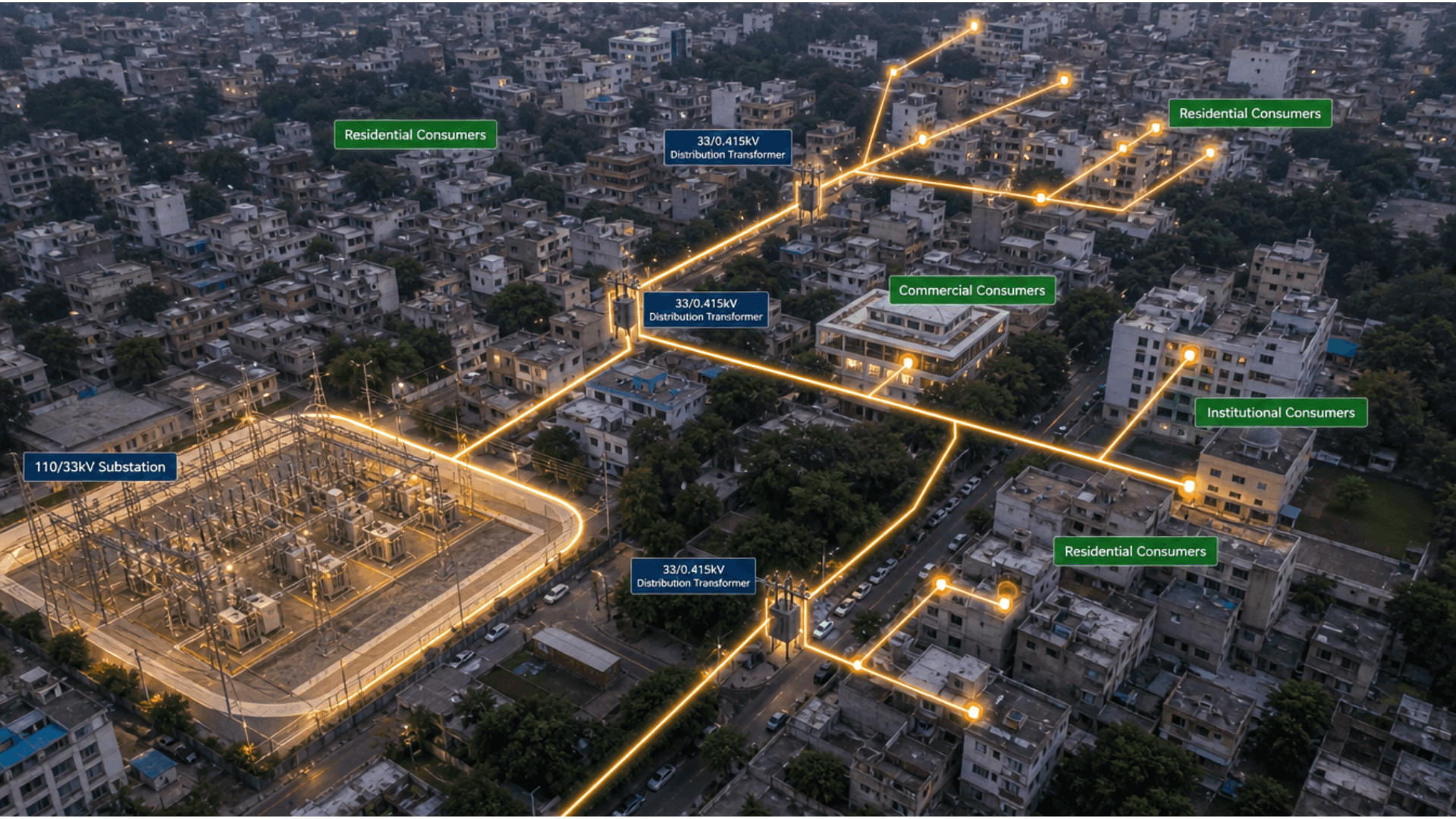
That means following electricity through the network: from feeders to distribution transformers and from those transformers to the consumers they supply.
Take an 11 kV feeder. A DISCOM may know how much energy entered it during the month. To calculate the losses further downstream, it also needs to know how much reached each DT (distribution transformer) and which consumers are actually connected to those DTs.
This is where the accuracy of consumer indexing matters.
A smart meter can tell the utility how much electricity a consumer used. But if that consumer is mapped to the wrong DT in the utility's records, the energy balance at the transformer level will also be wrong. One DT may appear to have a higher loss while another appears healthier simply because the underlying consumer mapping is incorrect.
BEE's energy accounting framework therefore requires both network-asset and consumer mapping as prerequisites for the exercise.
For energy accounting to work at the DT level, the utility first needs to know which consumers are actually connected to each transformer. WorkOnGrid’s Consumer Auto Indexing, built into Grid AI, tackles that part of the problem. It uses consumer and DT location data to narrow down likely connections, then compares their outage and restoration patterns to identify the probable mapping. Those relationships can then be validated and pushed back into systems such as the MDM (Meter Data Management) or GIS (Geographic Information System).
Energy accounting needs an accurate network view
NDMC serves some of Delhi’s most important government, institutional and diplomatic areas. The case puts a high-profile example behind a requirement every DISCOM faces: knowing how energy moves through the network and where the difference appears.
This further requires having the right consumer-to-DT relationships in place and being able to maintain them as the network changes.
Book a demo to see how WorkOnGrid can strengthen consumer mapping and energy accounting for your distribution network.