
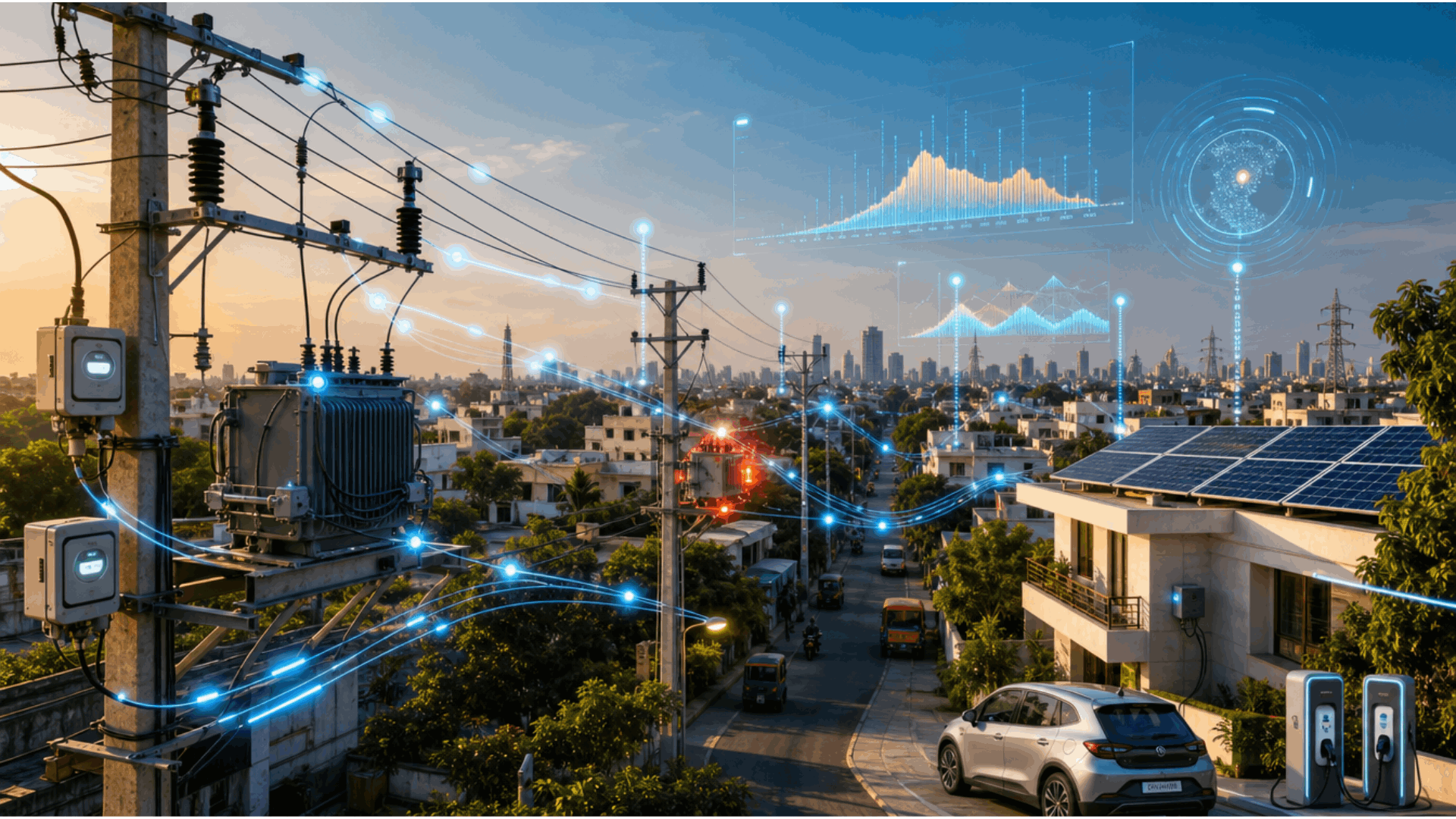
Gartner predicts that by 2027, 40% of power and utilities will deploy AI-driven operators in control rooms. Its 2025 CIO and Technology Executive Survey also found that 94% of power and utility CIOs planned to increase AI investment, with spending expected to rise by an average of 38.3%.
For DISCOMs, this interest in the AI smart grid comes at a time when smart meters, sensors and operational systems are already generating far more data across the distribution network.
The challenge is no longer just getting visibility. It is about making sense of that data quickly enough to act on it. Utilities increasingly need to know what is likely to happen next, where a problem could develop and what deserves attention first. That is where AI is beginning to change the smart grid.
Why do smart grids now need more than visibility?
Smart grids have given DISCOMs a much better view of what is happening across the distribution network. But the network itself is also becoming harder to manage.
- Rooftop solar changes power flows during the day
- EV charging can create new local demand peaks.
- More smart meters and sensors mean utilities have far more operational data to interpret.
The International Energy Agency describes electricity systems as becoming digitalised, connected and decentralised, creating a bigger role for AI in forecasting and balancing more complex networks.
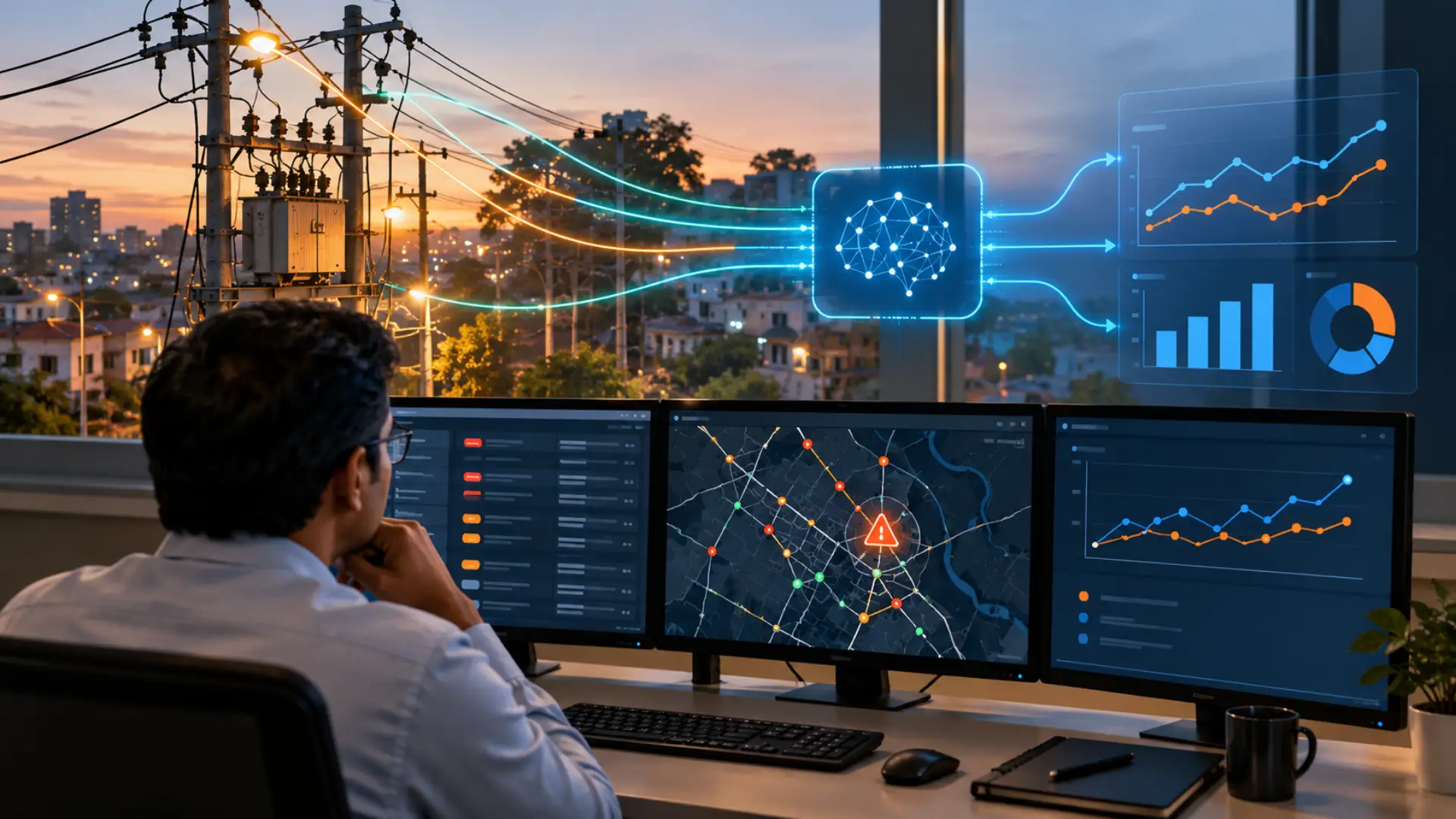
Take, for instance, a distribution transformer approaching overload. A monitoring system can show its present load and raise an alert when it crosses a set limit. What it cannot necessarily tell the operator is whether that transformer is likely to face a problem later in the day. AI can analyse that and historical patterns to help answer that question earlier.
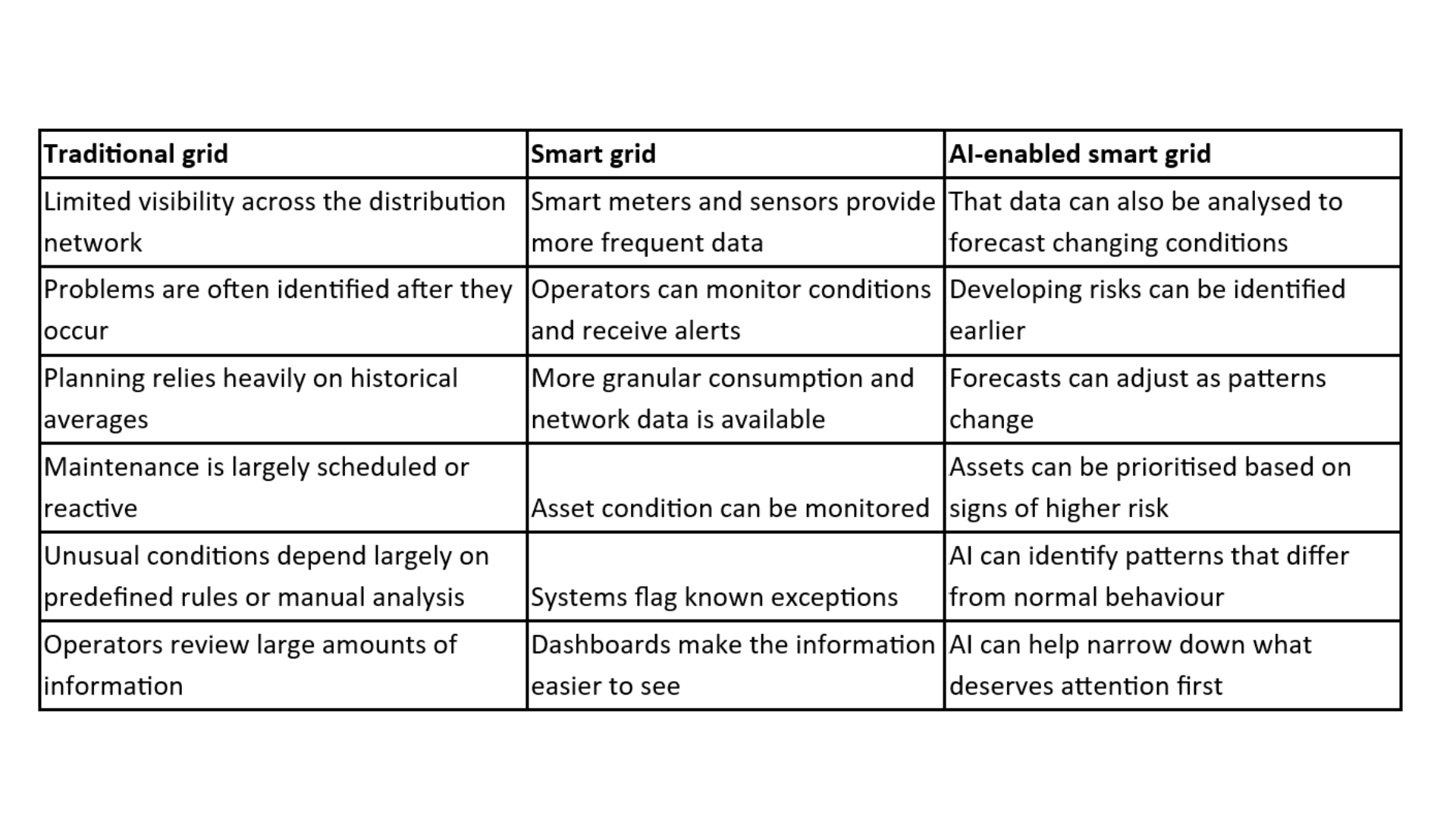
From a traditional grid to an AI-enabled smart grid
AI does not replace the smart grid, but it builds on the data and digital systems already in place.
Also Read: Smart Metering Data For Operational Intelligence and Load Forecasting : Grid
Where does AI actually enter grid operations: Use Cases Discussed
For a DISCOM, AI becomes useful when it improves a decision teams already make every day: forecasting demand, investigating unusual behaviour, maintaining network assets or deciding which issue needs attention first. Here are three practical use cases where that is already taking shape.
1. Seeing problems before customers do
Load and demand forecasting is the clearest case. Instead of planning against yesterday's averages, the system learns the patterns in your own network and predicts future loads by feeder. That information affects asset health as well. A distribution transformer heading toward failure usually shows that upcoming failure in loading, voltage, and temperature trends, long before it trips. AI reads those trends and warns you while there is still time to plan the swap, rather than after the consumers are affected.
2. Spotting what fixed rules miss
Most DISCOMs already use rules to flag known exceptions. The limitation is that rules only catch conditions the utility has already defined. But what happens when the pattern is unusual, yet no rule exists for it?
AI can help identify behaviour that differs from normal consumption or expected energy flows. This can further help teams spot possible metering issues, theft or unusual losses earlier, instead of waiting for the next review cycle to surface them.
3. Knowing what to fix first
One of AI’s most useful roles in utility operations is helping teams prioritise where to act first. A large network throws up thousands of alerts, anomalies, and maintenance candidates at once. AI ranks them by likely impact, so a limited crew spends the day on the transformer most likely to fail and the feeder losing the most units, not on whatever complaint came in last.
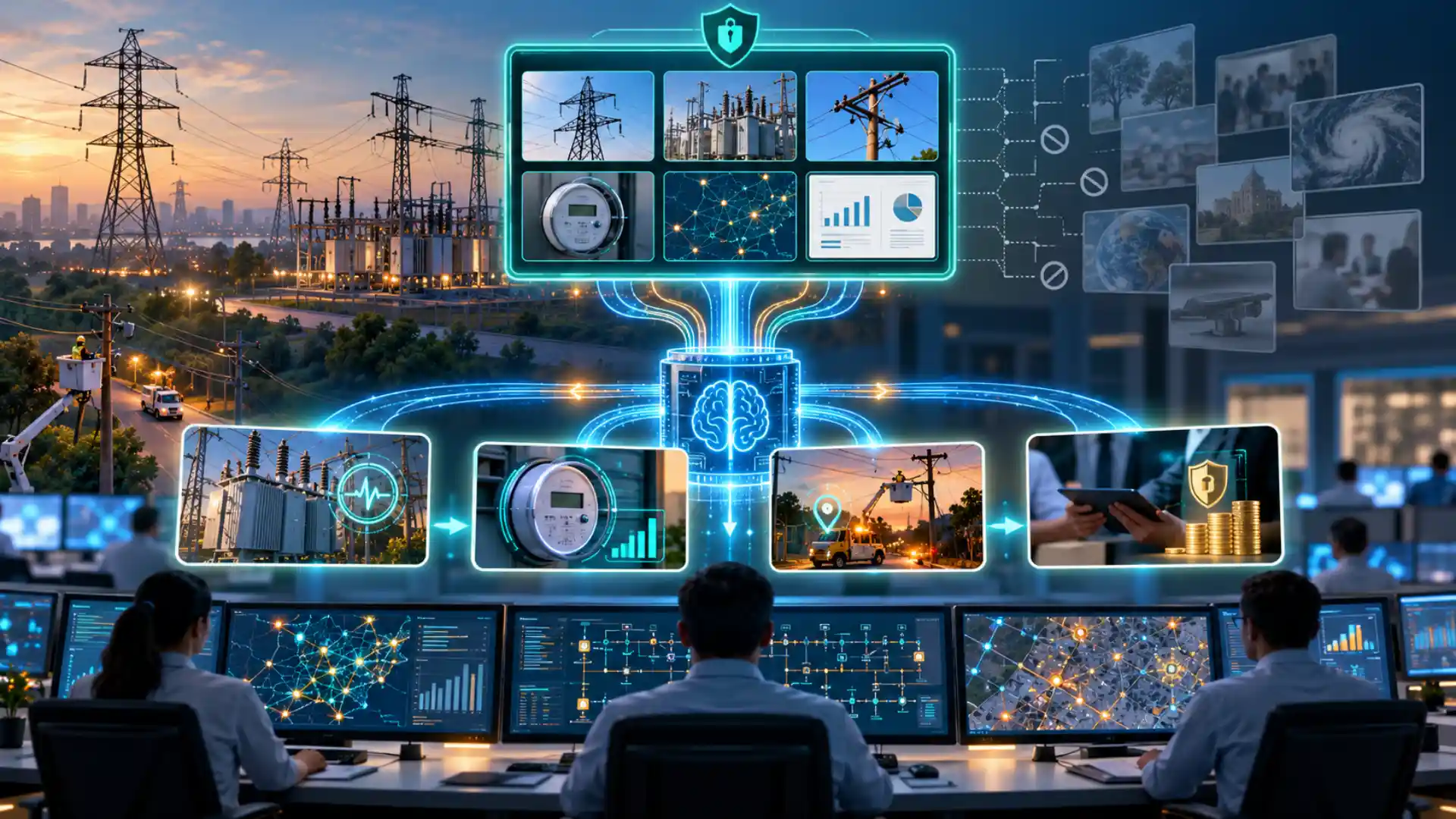
Forecasting, anomaly detection, asset health, and prioritisation all run on the same underlying data, which is why a DISCOM tends to see value in one area first and then find that the rest follow from the same foundation.
How an AI-enabled smart grid can improve service delivery for the DISCOM
Better prediction and faster decisions ultimately show up in the quality of supply the DISCOM delivers. According to Capgemini's 2026 research, approximately 6 in 10 electricity executives anticipate that advanced AI analytics will lead to over a 10% improvement in failure reduction, operational productivity, and the prevention and restoration of outages.
- Reduce avoidable interruptions: If changes in transformer loading, voltage or asset behaviour are identified early, teams have more time to investigate before the condition becomes critical. AI will not just prevent every outage, but it can help the DISCOM act earlier where the data already shows signs of increasing risk.
- Restore supply faster: When an outage occurs, the first challenge is understanding where the problem is and what needs attention. Using network, asset and outage data together can help operations teams narrow down the affected area and prioritise the response. That reduces the time spent diagnosing the issue before restoration work begins.
- Manage local demand before it affects supply quality: One area may see high rooftop-solar generation during the day and rising EV charging in the evening. Another may experience a sharp seasonal or commercial load increase. Better forecasting helps the DISCOM see where these changes are likely to put pressure on feeders or distribution transformers. That gives teams more time to manage loading and network conditions before they begin affecting voltage or reliability for consumers.
- Keep operating costs under better control: Not necessarily an immediate reduction in tariffs, but if teams can prevent some failures, restore supply faster, target maintenance more accurately and use existing network capacity better, the utility can reduce avoidable operating costs.
How AI smart grids can improve DISCOM operations and financial performance
The real value of AI becomes clearer when it helps a DISCOM make better decisions around the operational and financial outcomes it already tracks, from losses and revenue to maintenance spend, asset utilisation and capital investment.
- Protect revenue and focus on loss investigations: AI can surface unusual consumption, meter behaviour or energy-flow patterns that need verification. Instead of reviewing every case equally, revenue and operations teams can focus on areas where the data points to possible metering issues, theft or other forms of leakage.
- Use maintenance budgets more effectively: Not every transformer or network asset carries the same level of risk. By identifying assets that show signs of higher stress or abnormal behaviour, AI can help maintenance teams decide where inspections and preventive work should be prioritised.
- Get more from existing network capacity: Forecasting can show where feeders and transformers are consistently moving toward their operating limits and where capacity is still available. That helps DISCOMs make better use of existing infrastructure before moving directly to augmentation or expansion.
- Prioritise capital where it is needed most: AI can also strengthen longer-term investment decisions by showing where load is growing, which assets are repeatedly under stress and where network conditions are changing. This is also a stronger base for deciding which feeder, transformer or area should receive capital first.
Want a live example of how this works? Also Read: Ask, Build, Watch: How Grid AI Handles Transformer Health : Grid
What should DISCOM leaders focus on now?
The starting point does not need to be a large “AI transformation” programme. But a more useful approach would be to begin with an operational decision that is currently difficult, slow or reactive.
DISCOM leaders can ask:
- Where are we still finding problems only after a threshold is crossed, an asset fails or a consumer complains?
- Which decisions would improve if teams had a few hours or days of additional warning?
- Where are people manually comparing information from multiple systems before deciding what to do?
- Which alerts or anomalies consume large amounts of operational time?
- Where could earlier detection help reduce losses, protect revenue or improve maintenance?
- Is the underlying meter, network and asset data good enough to support the decision?
These questions keep the conversation focused on the outcome rather than the technology.
What makes AI in the grid actually work
You can agree with every point above and still be stuck. Knowing AI matters is not the same as being able to use it. What usually stops a DISCOM is not ambition or budget. It is the state of the data.
The problem underneath
AI is only as good as the data feeding it, and in most DISCOMs that data is scattered. Meter reads sit in the head end. Asset records sit in another system. Network topology, outage history, and billing each live on their own. None of it was built to be read together. A lot of it is also incomplete or unvalidated, with missing intervals, wrong mappings, and reads that were never estimated properly. Point a model at data like that and you get a confident answer you cannot trust. This is the real reason smart meter programs stall short of the value they promised.
How WorkOnGrid helps
WorkOnGrid helps utilities use the data they already have more effectively. The platform connects systems such as HES, MDM, SCADA, billing, GIS and work management, bringing the data into one usable view without replacing existing infrastructure.
Grid AI works on top of that connected data. Teams can ask questions in plain language and get answers they can act on. For example, in transformer health monitoring, Grid AI can compare asset patterns across the network, identify transformers showing higher risk and help teams focus on the right cases first. The same approach can support multiple use cases such as outage analysis, loss investigations, billing exceptions and network stress.
For DISCOM teams, the value is simple: less time pulling data from different systems and more time using it to make decisions. Talk to an expert, and we’ll help you identify where AI can add practical value in your grid operations.

-compresso.webp)


