South Africa has announced R500 million public-private investment initiative to reduce non-revenue water (NRW) between 2026 and 2031, as an estimated 47% of treated water nationally fails to generate revenue.
The scale of the challenge is evident in Tshwane, where annual water losses are estimated at R2.2 billion. For water utility leaders facing similar financial pressures, the investment raises an important operational question: how do you target limited funding at physical leakage without overlooking revenue lost to metering errors and unbilled consumption?"
The programme will begin with pressure management to reduce leakage and infrastructure for industrial effluent monitoring, with plans to expand beyond Tshwane.
Key Takeaways
- South Africa aims to mobilise R250 million in private investment, matched by public-sector funding, over 5 years.
- Tshwane reports approximately R2.2 billion in annual water losses, with ageing infrastructure and leakage accounting for the largest share.
- Initial measures target physical leakage, while the municipality also faces losses from unauthorised consumption and inaccurate metering.
How Will the R500 Million Investment Address South Africa's NRW Challenge?
Announced on October 7, 2026, the South Africa Non-Revenue Water Mechanism aims to attract private investment into municipal water infrastructure and NRW reduction.
According to the official announcement, private-sector partners aim to mobilise R250 million, matched by public-sector partners, between 2026 and 2031.
The initiative brings together the Coca-Cola system, South Africa's Department of Water and Sanitation, Rand Water Services, the World Bank Group's 2030 Water Resources Group and other partners.
The scale of existing water losses puts this investment into perspective. Tshwane's April 2026 water balance estimated approximately R2.2 billion in annual water losses. Separately, city officials reported in September 2025 that its master plan required R2 billion for pipe replacement and water-loss reduction, with only around 25% of the necessary funding available at the time.
The R500 million programme spans 5 years and is intended to support multiple municipalities, while Tshwane's R2.2 billion represents estimated annual water losses in a single municipality. This contrast highlights the importance of prioritising investments where they can address the sources of NRW.
For more on locating and investigating water losses, read our article on Non-Revenue Water: How Utilities Can Find, Diagnose and Reduce Water Loss.
How Will the R500 Million NRW Investment Be Used?
The first phase will begin in Tshwane, Gauteng, with 2 planned measures:
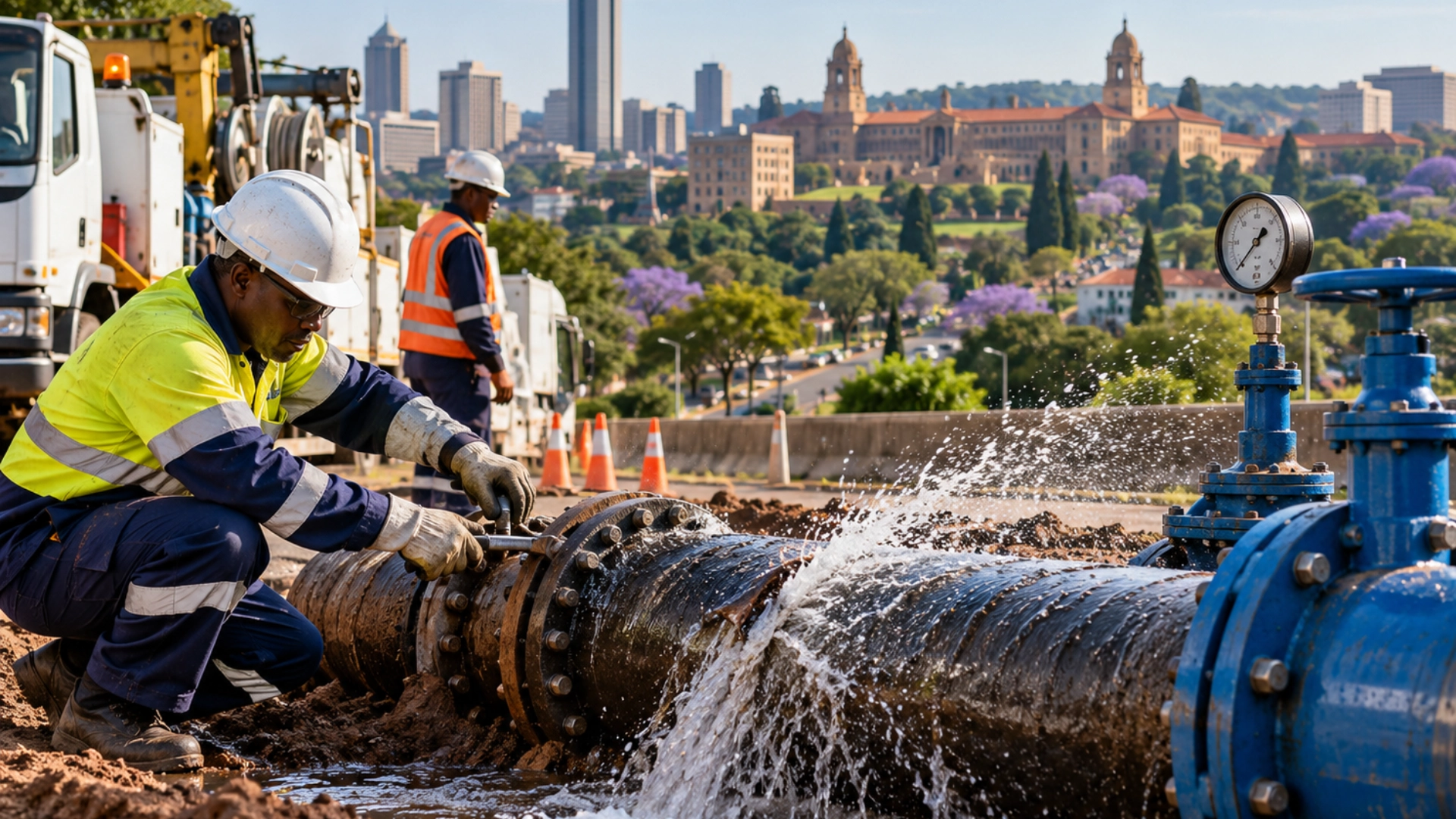
- Pressure management: Regulating pressure across water distribution networks to reduce physical leakage and pipe failures.
- Industrial effluent monitoring: Installing infrastructure to improve oversight and accountability for industrial wastewater discharges.
Pressure management directly addresses one of Tshwane's largest NRW problems.
According to Rekord's July 2026 report, the municipality's April 2026 water balance showed approximately 45% NRW.
The reported breakdown attributed:
- 34% to real losses caused by ageing infrastructure and leakage.
- 4% to illegal connections and unauthorised consumption.
- 4% to theft and other unbilled consumption.
- 3% to inaccurate or faulty meters.
These figures highlight the different sources of NRW that water utilities must address.
Pressure management can reduce physical leakage, while inaccurate metering, unauthorised consumption and unbilled connections require separate investigation and corrective measures.
Tshwane has set a target to reduce NRW to 36% by 2030/31. The new investment mechanism is expected to expand to other municipalities, although project-level funding allocations, programme-specific loss-reduction targets and additional implementation timelines have not been announced.
For utility leaders, the reported loss breakdown demonstrates why NRW reduction requires attention to both network infrastructure and the accuracy of consumption and billing records.
How WorkOnGrid Helps Water Utilities Detect Leakage and Identify Unbilled Consumption
NRW reduction also depends on identifying potential losses from available operational and smart meter data. WorkOnGrid supports water utilities in 2 relevant areas:
- Leakage detection: Analysing smart meter data and applying segment-specific thresholds to identify potential leakage cases requiring investigation.
- Revenue protection: Automatically identifying meters that continue recording consumption but remain unmapped, allowing utility teams to investigate and resolve the exceptions.
In a water utility revenue protection case study, WorkOnGrid supported a utility managing more than 480,000 smart meters. The implementation surfaced 95,430 devices with leak alarms within 72 hours and identified unmapped but consuming meters for resolution.
These capabilities help utilities investigate both potential leakage and consumption that may be missing from billing records. The reported alarm count represents potential cases, rather than confirmed leaks repaired or NRW savings achieved.
Talk to our team to explore how WorkOnGrid supports leakage detection and revenue protection using utility data.