For a water utility managing thousands of smart meters, the challenge is determining which customer connections actually require a leak investigation. With large volumes of consumption readings coming in regularly, identifying buildings with potentially significant leakage requires more than simply flagging unusual water usage.
A February 2026 study analysed one year of hourly smart meter readings from 21,845 users, applying a minimum night-flow method to identify days showing potential leakage.
Smart water meter leak detection through night-flow analysis helps utilities identify sustained changes in overnight consumption and narrow down the connections that warrant investigation. This gives operations teams a clearer starting point for directing attention towards suspected leaks supported by meter evidence.
What Is Night-Flow Analysis and How Does It Help Detect Water Leaks?
Night-flow analysis examines water consumption during overnight hours, typically between 2 AM and 4 AM, when demand is generally at its lowest. Water utilities use this period to identify continuous or unusually high flows that may indicate leakage.
Traditionally, utilities use minimum night flow (MNF) analysis to assess leakage within District Metered Areas (DMAs). By measuring the water entering a DMA and accounting for legitimate overnight consumption, they can estimate potential network leakage. The International Water Association's DMA Guidance Notes explain this approach.
With smart water meters, utilities can also examine overnight consumption at individual customer connections. This helps identify suspicious consumption patterns at specific buildings, rather than relying solely on area-level flow measurements or changes in monthly consumption.
How Can Utilities Use Smart Water Meter Readings to Identify Abnormal Night Flow?
For utilities managing thousands of customer meters, the challenge is identifying where overnight consumption has changed significantly from its usual pattern. This requires comparing readings from consistent time periods and examining whether the lowest recorded consumption remains elevated.
The analysis involves 3 checks:
- Compare readings from the same overnight window: Select a low-demand period, such as 2 AM to 4 AM, and examine the hourly consumption recorded at each meter. Check timestamps, and reporting intervals to ensure the measurements are comparable.
- Track changes in minimum overnight consumption: Establish a historical baseline for each smart water meter and compare it with recent overnight readings. If the meter consistently records more water consumption during its lowest-usage periods than it did previously, this could indicate a continuous leak or a change in the property's water usage.
- Examine how the change develops: A sudden increase that persists over consecutive nights may indicate a newly developed issue. A gradual rise in the nightly minimum may reveal a slower change that would be difficult to identify from a single day's readings.
Example: Identifying an Elevated Night-Flow Pattern
Consider a customer smart water meter whose historical hourly consumption is typically between 0 and 1 cubic meters (cu m) during the selected overnight window.
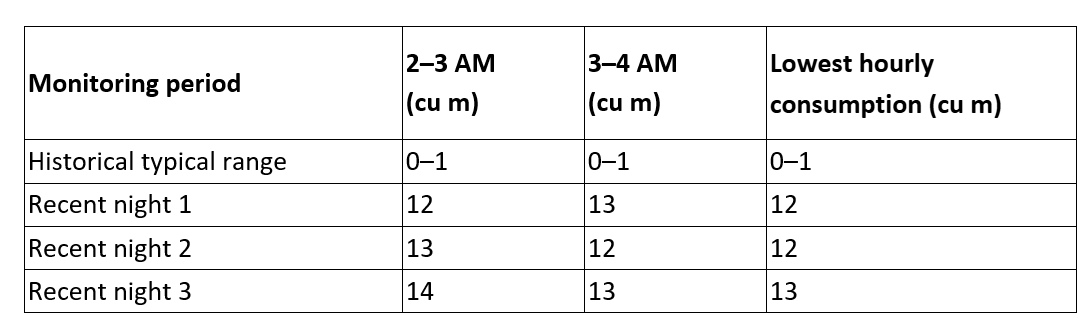
Illustrative readings, not actual customer data.
The meter's lowest hourly consumption increased from its historical range of 0–1 cu m to 12–13 cu m across 3 consecutive nights. This indicates a sustained change in overnight water consumption rather than an isolated instance of high usage.
For a utility operations team, the useful output is a record showing the affected meter, historical minimum consumption, observed deviation and number of nights affected. Applying this analysis across customer meters helps identify unusual overnight consumption patterns without requiring manual review of individual consumption histories.
However, hourly consumption readings cannot establish whether water flowed continuously throughout each hour or confirm that the increased consumption resulted from a leak. The utility must assess these findings against the customer's normal operating conditions before treating them as suspected leakage.
How Can Utilities Distinguish Potential Leaks from Normal Overnight Consumption?
Once abnormal night-flow patterns are identified, utilities need to assess them against the type of customer and how the building operates. A single consumption threshold applied across all connections can produce misleading results because overnight water demand varies considerably.
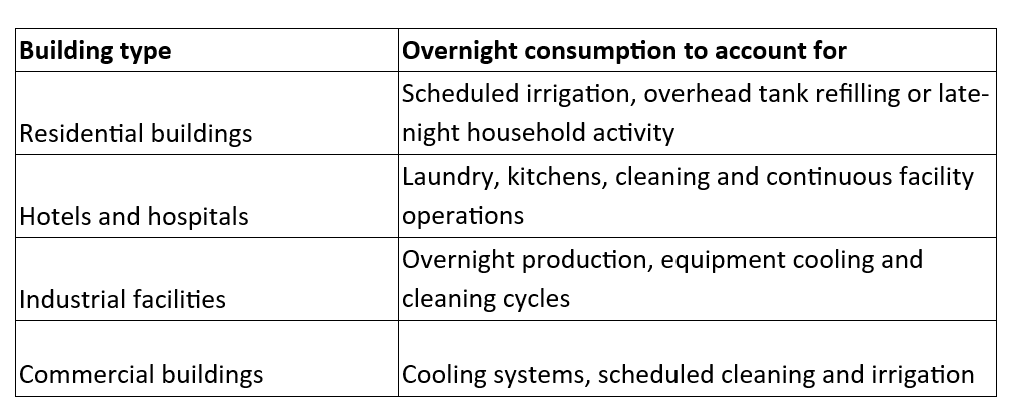
Utilities can use customer categories, historical meter readings and segment-specific consumption thresholds to assess flagged connections. However, specific activities such as laundry schedules, production hours or tank refilling may require confirmation from the customer or an on-site investigation.
For example, a hotel running laundry equipment overnight may regularly record water consumption at 3 AM. A comparable overnight consumption reading from a residential building with no known overnight activity would require closer examination. Meter readings can reveal the consumption pattern, but they cannot independently establish which activity caused it.
This is where segment-based leakage detection becomes useful. WorkOnGrid helps water utilities analyse smart meter readings using leakage thresholds configured for different customer categories, such as residential and industrial connections. Rather than applying one rule across the entire meter population, the system can flag unusual consumption based on the relevant segment.
In a water utility implementation covering more than 480,000 smart meters, this approach was used to support leakage detection and field operations.
These checks help utilities separate consumption that may be explained by normal building operations from suspected leakage requiring further attention. Once those cases are identified, the next decision is which ones should be investigated first.
How Should Water Utilities Prioritise Buildings with Suspected Leaks?
A water utility may identify hundreds of buildings with suspected leakage, but investigating every case with the same urgency is rarely practical. Teams need to determine which cases represent the greatest potential water loss and require immediate attention.
Utilities can prioritise suspected leaks using the following considerations:
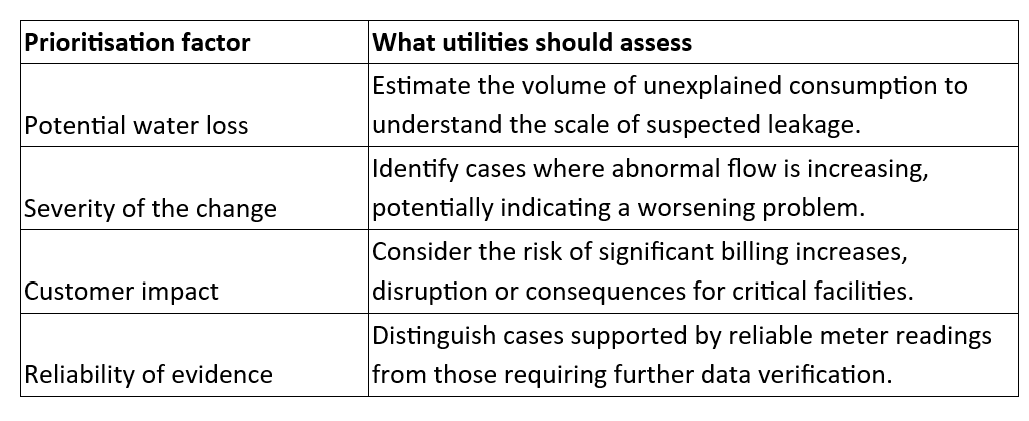
Consider two buildings flagged for suspected leakage. Building A records an excess average flow rate of 0.015 cu m/h over 7 nights, while Building B records 0.15 cu m/h over 2 nights.
Assuming both buildings maintain these average rates during the same two-hour monitoring window each night:
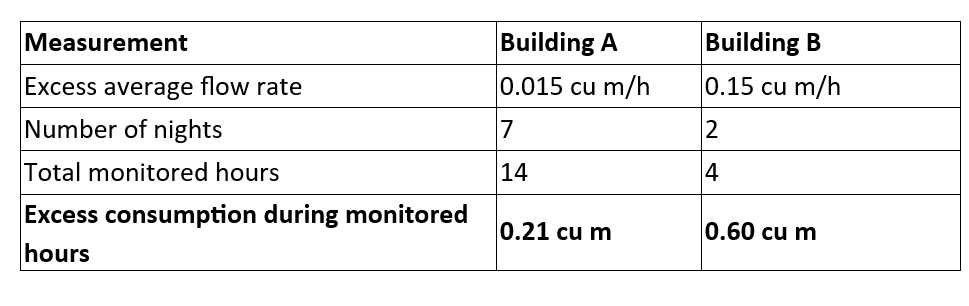
Illustrative calculations based on excess consumption above the expected baseline during the monitored hours, not confirmed leakage volumes.
Although Building A has shown abnormal consumption for longer, Building B records nearly three times the excess water consumption during the monitored periods. Its substantially higher average flow rate may warrant more urgent investigation, assuming the readings are reliable.
For water utility operations teams, the objective is to turn suspected leakage findings into a prioritised investigation queue, with the potential water loss, urgency and supporting evidence available for each case.
This allows teams to direct their attention towards higher-impact cases while retaining lower-priority findings for subsequent review.
How Can Utilities Investigate Suspected Leaks and Verify Resolution?
Once a suspected leak is prioritised, the next step is ensuring the right team investigates it and confirms whether the issue has been resolved. This requires clear ownership, recorded findings and follow-up using subsequent meter readings.
- Assign responsibility for investigation
The appropriate response depends on where the suspected leak occurs. For potential leaks within a customer's property, the utility may need to notify the customer and share the abnormal consumption findings. Suspected issues involving utility-owned infrastructure may require field inspection.
With WorkOnGrid, utilities can configure rules that trigger investigation tasks when suspected leaks meet predefined conditions. Each task can include the affected meter, location and supporting consumption records, and be routed to the responsible team. For example, cases requiring customer notification can go to customer service, while those requiring field inspection can be assigned to field operations. The platform then tracks the assigned task through closure.
- Record the investigation outcome
Each investigation should establish whether the abnormal consumption resulted from a confirmed leak, legitimate water usage or another cause. Recording these outcomes gives utility teams a clear account of which cases require further action and which can be closed.
- Verify resolution through subsequent meter readings
After corrective action, utilities can review subsequent night-flow readings to check whether consumption has returned towards its expected pattern.
For example, if a building previously recorded elevated overnight consumption due to a confirmed leak, a reduction after repair provides supporting evidence that the intervention was effective. However, meter readings alone do not conclusively verify the repair. Utilities should consider them alongside customer confirmation or field inspection findings, where applicable.
This closes the loop between leak detection and resolution, allowing utilities to assess outcomes using both consumption data and investigation records rather than relying solely on reported repairs or completed tasks.
From Night-Flow Analysis to Leak Investigations with WorkOnGrid
WorkOnGrid brings smart water meter readings into a unified system, checks data completeness against expected reporting intervals, and applies segment-specific leakage thresholds to identify potential issues across customer connections.
When a suspected leak requires investigation, the platform can automate task creation, assign responsibility to the relevant team and track progress through closure. This connects consumption analysis with operational follow-up without requiring teams to manually coordinate between disconnected systems.
Talk to our experts to see how WorkOnGrid can support smart water meter leak detection across your network.