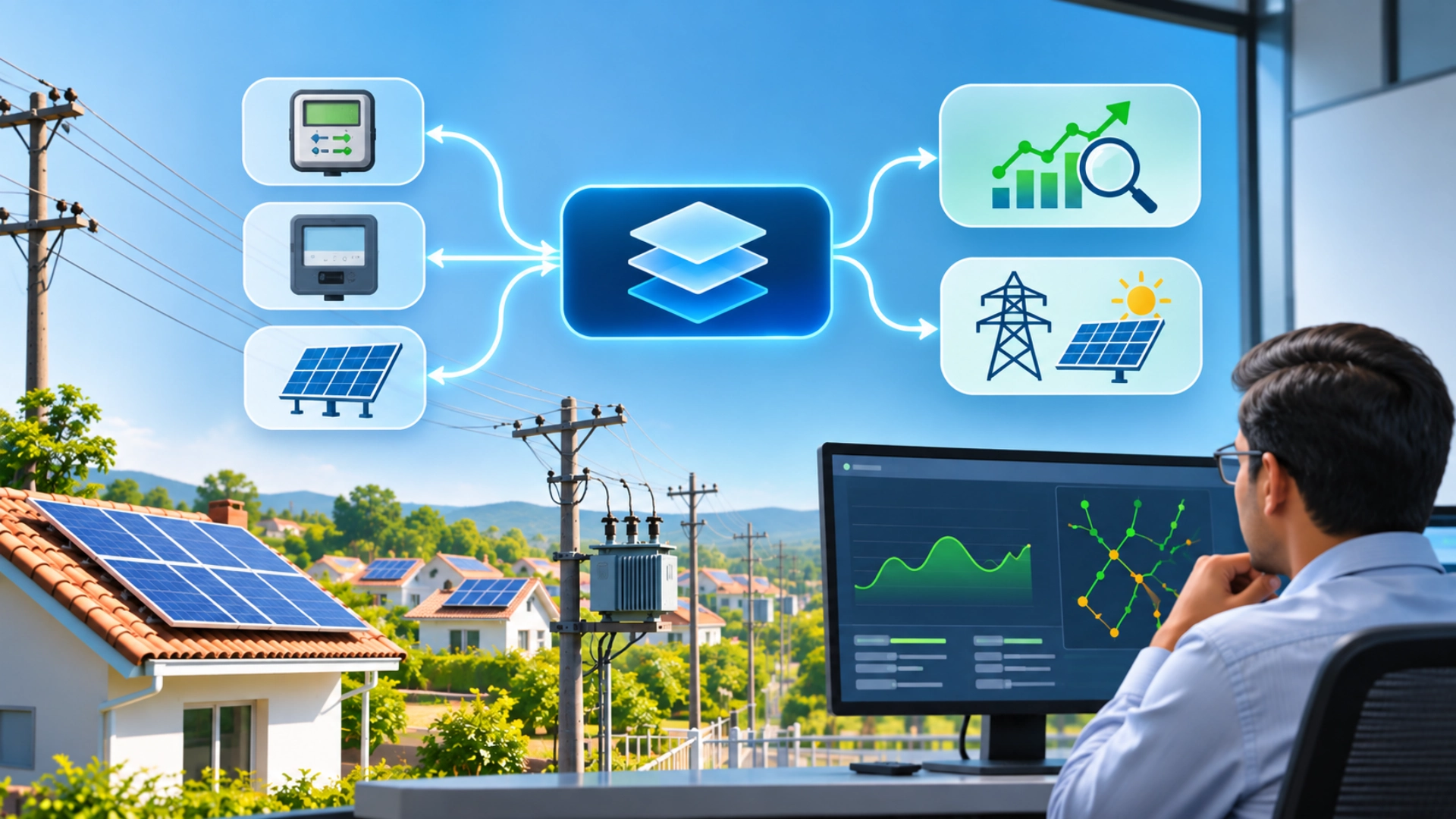
A DISCOM may have net meter readings showing how much electricity rooftop solar consumers import from and export to the grid. It may also have feeder and transformer measurements. But can its operations team connect these readings to understand how distributed energy resources (DERs) are affecting a particular feeder?
India's grid-connected rooftop solar capacity reached 34.97 GW as of October 31, 2026, according to the Ministry of New and Renewable Energy (MNRE). As DER installations grow, fragmented measurements make it harder to assess network conditions. The International Energy Agency (IEA) identifies combining fragmented feeder, substation, transformer and smart meter data into operational capabilities as a key challenge for distribution utilities.
For effective DER integration, DISCOMs need to connect existing measurements with accurate network information, understand what the data reveals about feeder conditions, and identify where additional investigation or engineering assessment is required.
Why DER Integration Needs a Feeder-Level View
Net meters show how much electricity individual consumers import from and export to the grid. However, DER integration decisions require DISCOMs to understand how these flows affect the feeder as a whole.
For instance, rooftop solar exports during periods of low electricity demand may contribute to reverse power flows or voltage rise. The impact depends on local demand, network configuration and operating conditions.
DISCOMs therefore need to connect consumer-level readings with the correct feeders and transformers and examine them alongside network measurements. This helps identify where additional DER connections may require closer technical assessment.
What Can DISCOMs Measure Through Net Meters, Feeder Meters and Other Systems?
DISCOMs have several sources of information for assessing distributed energy resources (DER) integration. Each provides a different view of electricity flows and network conditions, depending on the metering and monitoring infrastructure installed.
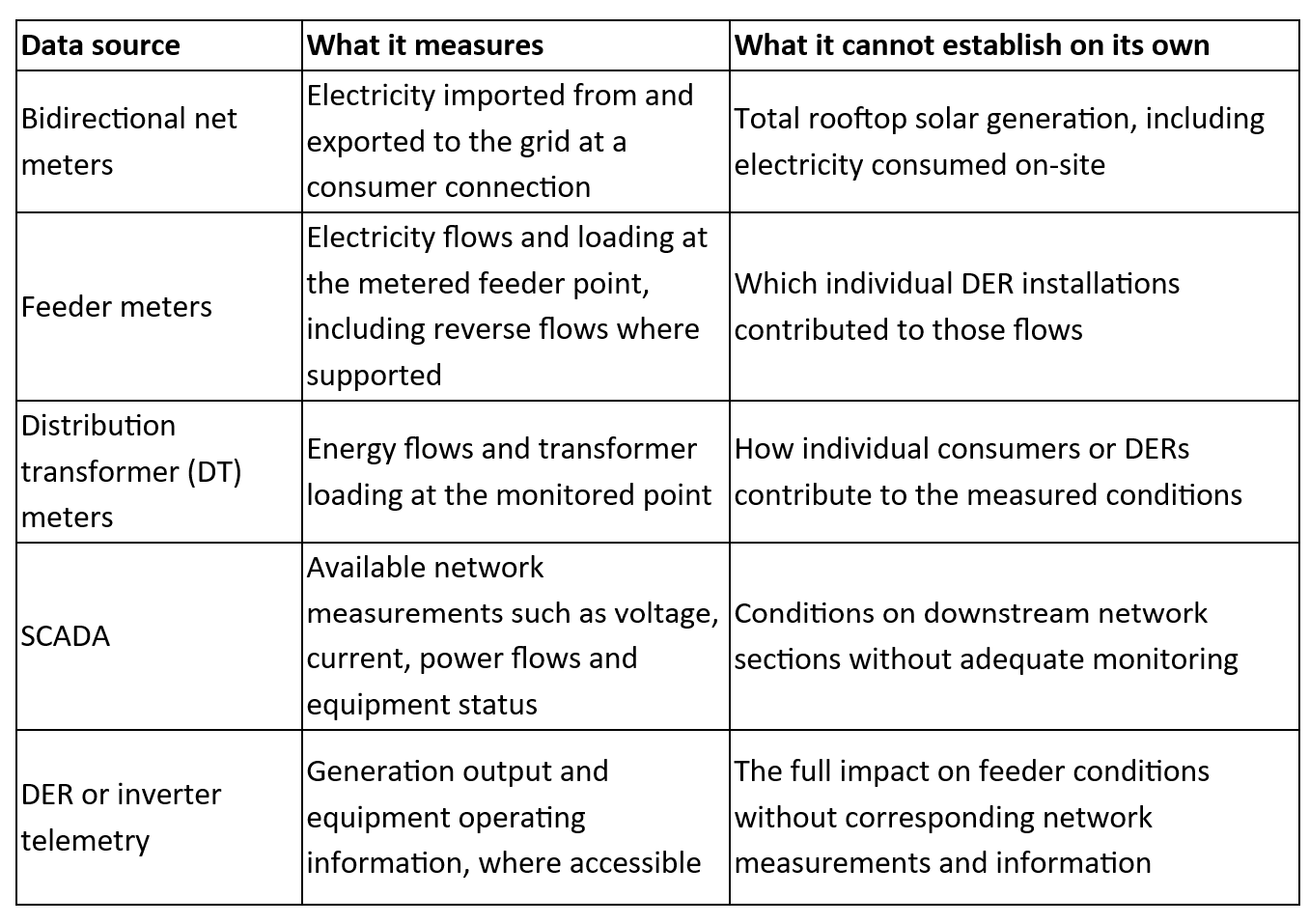
The important distinction is between measuring a network condition and identifying its cause. A feeder meter may confirm a change in loading, but determining whether DER activity contributed to that change requires further analysis.
For DISCOMs, recognising this difference helps separate confirmed network conditions from potential DER-related issues that need further investigation.
How Can DISCOMs Bring DER and Network Data Together?
For DER integration, DISCOMs need more than a collection of meter readings. They need to establish which measurements belong to a particular feeder, whether they represent the same operating period and whether the underlying data is reliable.
This involves 3 important steps:
Map Consumers and DERs to the Correct Feeders and Transformers
The first step is establishing accurate network relationships. A consumer may have a registered rooftop solar installation and a functioning net meter, but the corresponding records must identify the correct distribution transformer (DT) and feeder.
This requires matching consumer and meter identifiers with DER connection records, DT information and network topology. Outdated or incorrect connections can cause readings to be attributed to the wrong network assets.
The India Smart Grid Forum's National Solar Rooftop PV Registry reflects the importance of these network relationships by organising rooftop solar installations at the DISCOM, feeder and DT levels.
In WorkOnGrid's consumer-to-DT mapping case study, a customer managing approximately 700,000 smart meters found that 42% of its existing consumer-to-DT mappings were incorrect. By analysing location and outage data, the customer improved mapping accuracy from 58% to 95%.
Where network connections cannot be verified, DISCOMs should flag those records before using them for feeder-level DER analysis.
Align Measurements from the Same Time Period
Once the network relationships are established, DISCOMs need to compare measurements that represent the same operating period.
For example, a net meter may record electricity exported between 12:00 PM and 12:15 PM, while SCADA provides feeder power measurements at specific moments. Comparing the 15-minute energy total directly with a single instantaneous power reading would be misleading.
The analysis must account for measurement intervals, timestamps and units. Import and export directions must also be interpreted consistently across systems.
This becomes particularly important when analysing changes during high rooftop solar generation periods. Time-aligned measurements allow engineers to examine whether changes in consumer exports occurred alongside changes in feeder loading or voltage, without assuming that one necessarily caused the other.
Validate Readings and Identify Data Gaps
Before analysing DER-related network conditions, DISCOMs need to check the completeness and quality of the available measurements. Missing meter intervals, incorrect import/export values, inconsistent units and gaps in telemetry can affect the reliability of the analysis.
For example, if a solar consumer's export readings are missing during a particular period, the DISCOM should not interpret the absence of data as zero electricity exported. The missing readings must be flagged, and the affected period excluded from conclusions that require those measurements until the data is recovered or an appropriate estimation method is applied.
The National Renewable Energy Laboratory's guidance on data validation emphasises the importance of identifying errors in source databases and correcting them before relying on the results of distribution network studies.
How Can DISCOMs Use Feeder Data to Make DER Integration Decisions?
Once DISCOMs have reliable feeder-level information, they can use it to investigate operating conditions and provide better inputs for DER connection and network planning decisions.
Identify Feeders That Require Operational Investigation
DISCOMs can examine feeder loading, voltage measurements and power-flow direction alongside rooftop solar export patterns to identify conditions that need attention.
For example, suppose a feeder records reverse power flow during midday hours, while voltage readings from connected consumers show repeated increases. The operations team can identify when these conditions occur, which network sections are affected and whether the measurements exceed applicable operating limits.
This evidence helps engineers prioritise feeders for investigation, review voltage regulation and protection arrangements, and determine whether corrective action is necessary. The findings can also be passed to the appropriate network operations or field teams for verification.
Support New DER Connection and Network Upgrade Assessments
When additional rooftop solar connections are proposed, DISCOM planning teams need to assess whether the existing network can accommodate them without violating voltage, thermal or protection requirements.
Historical feeder loading, minimum daytime demand, voltage profiles and existing DER information provide important inputs for these assessments. Engineers can use them to establish realistic operating conditions for load-flow and hosting-capacity studies, rather than relying solely on registered solar capacity.
A CSTEP study conducted with APEPDCL in Andhra Pradesh illustrates why such assessments matter. In its modelled industrial-feeder scenario, rooftop solar reduced distribution transformer loading from 104% to 78%, demonstrating that DER integration can also relieve network loading under suitable demand conditions.
For DISCOM leaders, these assessments help determine which connection proposals require detailed engineering review and where network reinforcement, voltage regulation or other interventions may be needed.
Reliable feeder-level data strengthens these decisions, while specialised engineering studies establish whether proposed DER connections and network changes can operate safely.
Supporting DER Integration with WorkOnGrid
As distributed energy resources grow, DISCOMs need reliable information about feeder conditions to assess new connections, investigate operational issues and plan network improvements.
WorkOnGrid helps utilities bring together smart meter readings, available DER data and network information for operational analysis. With accurate network mapping, consumption and voltage analysis, and automated workflows, DISCOM teams can investigate unusual operating conditions and route findings to the appropriate teams for follow-up.
Talk to our team to see how WorkOnGrid can help your utility make better use of its existing data for DER integration decisions.