India's Ministry of Power has issued a revised draft of the Electricity (Rights of Consumers) Amendment Rules, 2026, proposing automatic reviews of unusually high or low electricity consumption, revised time-of-day tariff deadlines and changes to rooftop solar and energy storage requirements.
Under the proposed billing safeguards, utilities would need to identify consumption exceeding 5 times or falling below 1/5th of the average of the previous 6 billing cycles and resolve flagged cases within 30 days of bill generation.
The revised draft was circulated on November 23, 2026, with stakeholder comments invited until December 23, 2026. The amendments are proposed to take effect from April 1, 2027.
The proposal raises a practical question: how can utilities automatically identify unusual consumption, access the relevant meter and billing records, and investigate flagged cases efficiently?
Key Takeaways
- The proposed rules would require utilities to identify and review unusually high or low consumption against the preceding six billing cycles.
- Utilities would have 30 days to resolve flagged billing cases. Consumers would also receive conditional protection against disconnection while the review is pending.
- The revised draft also proposes changes to time-of-day tariffs, rooftop solar, energy storage, new connections and consumer grievance redressal.
What Do the Proposed Billing Safeguards Require?
Under the Ministry's revised draft, utilities would be required to make suitable arrangements in their billing systems to identify cases of unusually high or low consumption.
State Electricity Regulatory Commissions (SERCs) may prescribe alternative limits based on consumption patterns within their states.
Utilities would have to review flagged cases and resolve them within 30 days of bill generation. The provision would become applicable within 6 months of the rules coming into force, or earlier once the necessary billing arrangements are ready.
The draft also proposes that electricity supply should not be disconnected while such a review remains unresolved, provided the consumer continues paying charges based on the average consumption of the previous six billing cycles.
The billing-review mechanism was included in an earlier March 2026 draft and has been retained in the revised November proposal.
What Other Changes Are Proposed for Utilities?
The revised draft covers several other areas of electricity distribution operations.
- Time-of-day tariffs: The proposed implementation deadline is April 1, 2028, for consumers with a maximum demand exceeding 10 kW. For other non-agricultural consumers, the deadline would be determined by the State Commission, but no later than April 1, 2029.
- Rooftop solar and energy storage: SERCs would have greater flexibility to determine net-metering limits and applicable charges. They may also require prosumers with renewable energy installations above a specified capacity threshold to install energy storage. The draft proposes a default threshold of installations exceeding 10 kW where no state-specific threshold exists, with storage capacity linked to at least 20% of daily renewable generation or another proportion specified by the Commission.
- Consumer grievance redressal: Utilities would need Consumer Grievance Redressal Forums at a minimum of two levels, including company and district or municipal levels. Grievances would normally be resolved within 30 days, with an outer limit of 45 days. The draft also calls for online complaint submission, virtual hearings and grievance tracking.
- New electricity connections: The proposal extends the three-day connection timeline to municipal corporation areas, alongside metropolitan areas, subject to the stated exceptions for work requiring network expansion or new substations.
The draft additionally proposes a regulatory framework for demand response programmes.
What Would an Automated Billing Review Look Like in Grid?
For utilities managing large consumer bases, the proposed billing-review requirement involves more than identifying unusual consumption. Teams need to review the relevant meter and billing records and manage investigations through resolution.
WorkOnGrid can support this process by bringing together consumption and billing records, applying configured checks to flag unusual readings, and creating tasks for responsible teams to investigate and track through closure.
Consider a consumer whose average consumption over the previous six billing cycles is 100 kWh, but whose current billing-cycle consumption reaches 600 kWh.
A utility could configure Grid to support the following process:
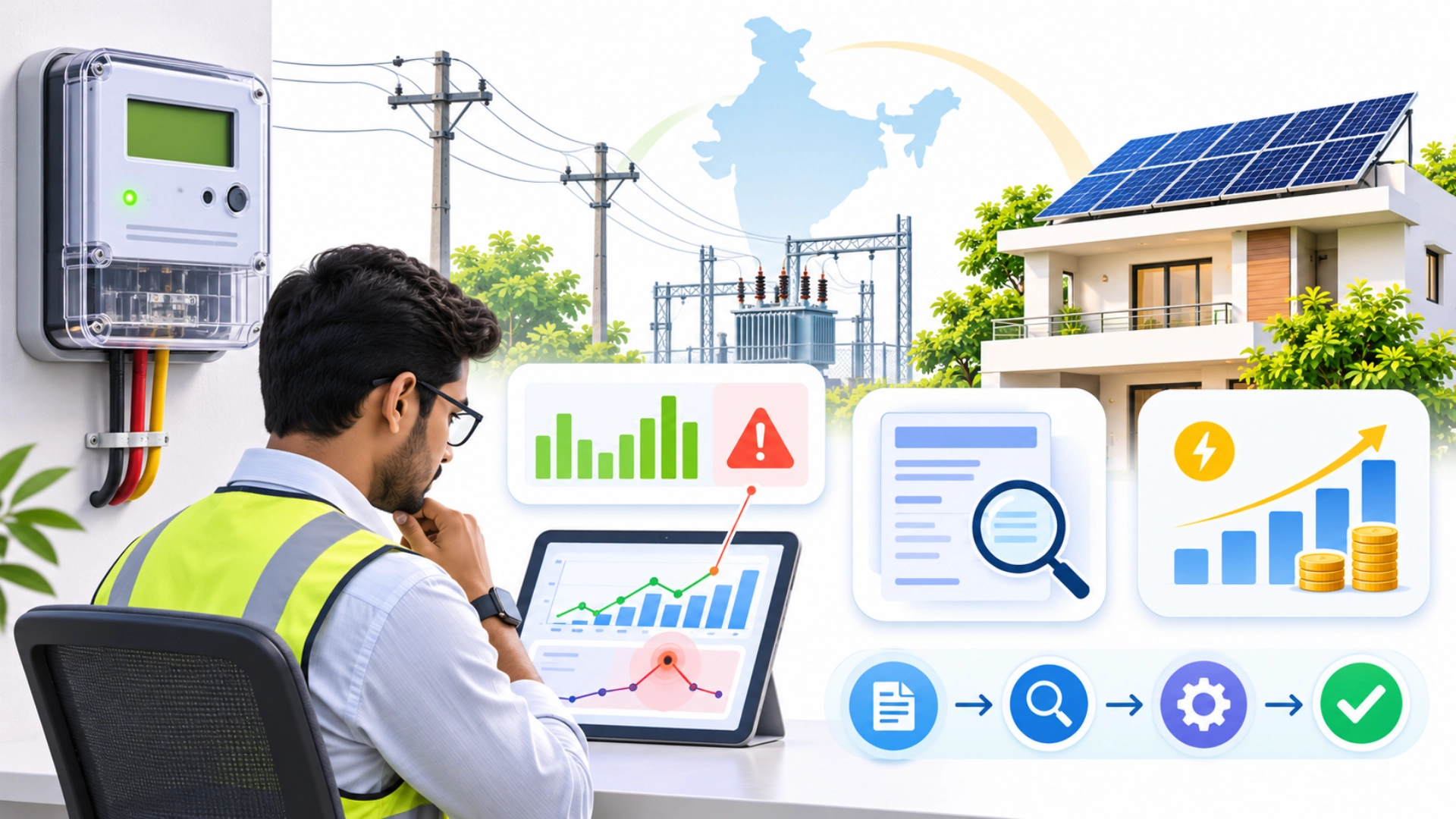
- Identify the exception: Grid accesses the relevant consumption records from the utility's connected systems and compares the current billing-cycle consumption against the previous six-cycle average. In this example, the 600 kWh consumption exceeds the proposed threshold and is flagged for review.
- Examine supporting records: The responsible team reviews the consumer's historical consumption, meter readings and related billing information to determine whether the unusual reading requires correction or reflects an explainable change in usage.
- Assign and track the investigation: Grid can create a task for the flagged case, assign it to the responsible team and track its progress. Officials can review the associated consumer and consumption records, record their findings and close the task once the investigation is complete.
This example illustrates how Grid could support the proposed review process using configurable rules and workflows. By automating exception identification, task assignment and investigation tracking, Grid can reduce routine manual work and help existing utility teams handle more billing investigations without a corresponding increase in staffing.
The utility would remain responsible for reviewing flagged cases, resolving billing issues and meeting the applicable regulatory requirements.
Want to streamline billing-exception investigations in your utility? Talk to our team to see how WorkOnGrid can support consumption analysis, automated task assignment and investigation tracking.