.jpg)
Smart meters are showing up everywhere, across homes, commercial sites, and utility programs because they do more than just replace legacy meters. They provide a clearer, time-based view of consumption that’s hard to achieve with manual reads or monthly estimates.
These devices also enable two-way communication, allowing utilities to monitor consumption in near-real time, and flag exceptions sooner. In some cases, operators can also remotely start/stop service when safety or risk thresholds require it. This level of granularity also facilitates demand-response programs and DER planning, enabling utilities to measure what changed and when.
The upside is straightforward: better billing accuracy, faster issue triage, and stronger reporting for efficiency and sustainability efforts. But the ROI shows up consistently only when smart meters are treated as part of the AMI network, with clear workflows and ownership behind the data, not as a simple hardware swap.
The growing trend of smart meter adoption is already visible in the market.
- The United States smart meter market was valued at $4.37 Billion in 2024. It is estimated to grow at a CAGR of 7.6% and reach $8.50 Billion by 2033.
- Electricity smart meters held 68.02% of the US market share in 2025. Residential meters accounted for nearly 72% of the overall market in 2025.
In this blog, we will cover:
- What smart meters do well in AMI networks?
- What are associated risks with smart metering?
- How can utilities reduce those risks and stay ROI-positive?
What are the benefits of smart meters for utility networks?
The real benefits of smart meters begin to appear when the data becomes usable for billing, operations, and customer service. This means teams are able to detect issues early on, act upon it and deliver results without relying on guesswork.
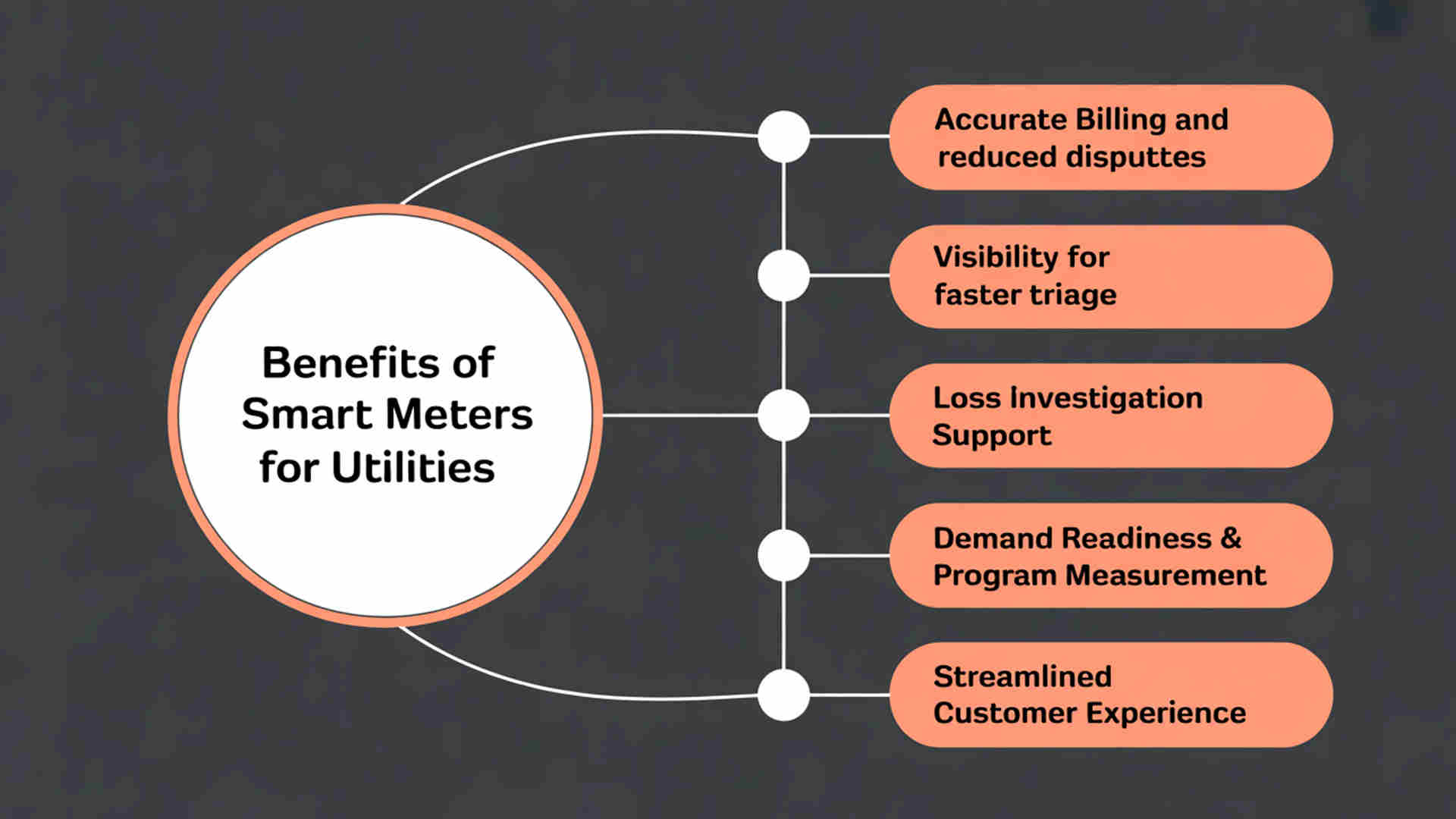
Some key benefits of smart metering are mentioned below:
Faster, more accurate billing, and reduced disputes
What it means: With smart meters, utilities can reduce their reliance on manual readings and estimates. This helps improve billing accuracy and makes it easier to detect exceptions.
Where it shows up: Reduced estimated bills, fewer truck rolls, and minimized repeat complaints.
Operational visibility for faster triage
What it means: Metering interval data and event flags enable teams to detect patterns early, so that issues do not turn into a backlog of complaints or field visits.
Where it shows up: Abnormal usage patterns, tamper indicators, outage suspicion and anomalies that signal “where to look first.”
Loss investigation support
What it means: Rather than treating losses as a broad factor, users can now narrow down to possible causes, based on location, segment and anomaly patterns.
Where it shows up: Prioritizing and completing tasks that are most likely to pay off first.
Peak demand readiness and program measurement
What it means: Improved internal visibility which makes it easier to understand when peak periods occur and whether reduction efforts have actually worked.
Where it shows up: Event measurement, planning support, and transparency into “what changed and when” proof for program reviews.
Streamlined customer experience
What it means: Smart meter data, when handled properly, helps reduce billing disputes since real-time up-to-date measurement helps eliminate estimations.
Where it shows up: Quicker dispute resolution, reduced repeat calls, and clearer usage explanations.
The above benefits explain why smart meters are gaining traction. However, if the program isn’t handled well at utility scale, data leakage can happen quietly, in the form of missing reads, false alarms, data gaps, customer pushback, etc. In the next section, let’s look at some of the most common risks associated with smart meters.
What are the common risks and disadvantages of smart meters?
At utility scale, even the most minute data gaps can multiply across thousands (or sometimes millions) of endpoints. Be it energy, gas or water smart metering, it is important to understand the most common risks early, which can help reduce ‘exceptions’ and ‘noise’ created by data mismanagement.
Customer trust and adoption risk
What it means: Customer pushback tends to happen when they see a change that they cannot generally explain. After rollouts, for instance, let’s say electricity smart meters, bills for certain customers may shift (since estimates are now being replaced by actual usage). This can create a sense of confusion or suspicion among customers if the utility didn’t communicate “what changed and why.”
Where it shows up: Delayed installations, complaint spikes, and higher cost-to-serve.
Data volume and operational overhead
What it means: Unlike traditional metering, these robust devices do more than transmitting real-time readings. For example, smart energy meters can help track events, exceptions, and repeated edge cases (such as duplicates, retries or missing/late reads). Without clear ownership and thresholds, teams often end up reviewing “exceptions” manually, which turns “more data” into “more administrative work.”
Where it shows up: Unresolved backlogs, increasing operational effort and alert fatigue.
Coverage and data quality gaps
What it means: Fieldwork can be a mess if there is no organized workflow in place. Firmware versions can differ, and some endpoints may communicate intermittently. This often results in incomplete time-series data, producing false alerts, and hiding real issues if the rules aren’t validated.
Where it shows up: Duplicate events, false positives, late/missing reads and inconsistent reporting.
Cybersecurity and privacy exposure
What it means: Data risks increase because the metering program expands the amount of granular data stored, and is also shared across vendors, head-end systems, and analytics tools. If access controls and audit logs are weak, it becomes difficult to prove who accessed that data, or why a rule or threshold was changed.
Where it shows up: Limited auditability, inconsistent permissions, unclear data retention, and vendor governance gaps.
Program complexity and vendor execution risk
What it means: Smart metering networks have multiple departments, from metering, IT, billing, operations, etc. All of these departments also often do not share the same definitions, (eg: what counts as “missing”, when an exception is “closed”), and teams get stuck in handoffs and disagreements instead of resolution.
Where it shows up: Integration delays, inconsistent KPIs, slow time-to-value, and stalled rollouts.
From a data management perspective, tracking these risks matters because return on investment depends on data being complete, trusted and actionable which teams can actually respond to.
How can utilities reduce smart meter risks and still capture ROI?
One of the quickest ways to protect smart metering ROI involves treating risk management as part of the program design, and not as a cleanup effort after rollout. In real-life cases, most issues tend to become expensive when ownership is unclear, data foundations are weak, and exceptions pile up without a consistent way to resolve them.
Below is a practical risk mitigation checklist for utilities:
Governance (who owns what)
- Assigning clear owners for key exception types (metering, billing or operations)
- Defining escalation paths and SLAs so issues do not get ignored and pile up
- Setting audit-trail KPIs early on: what must be logged, reviewed and approved
Data readiness (make data usable)
- Enforcing metadata completeness, specifically for meter-to-premise-to-feeder mapping
- Standardizing naming conventions for assets, sites and meters so reports do not sit in fragmented manner
- Tracking changes over time (equipment replacements, feeder reconfiguration)
Exception operations (avoid alert fatigue)
- Creating rules for late/missing reads, duplicates, and abnormal usage patterns
- Prioritizing exceptions by severity (revenue risk, safety risk, repeat frequency), not by data volume
- Closing the loop: every exception should have a resolution status and feedback that helps streamline future workflows
Security basics (reduce exposure)
- Establishing RBAC (role-based access control) aligned to utility roles, and not generic user types
- Maintaining audit logs that track every rule change, override, and data access
- Separate duties where it matters (the person changing rules shouldn’t be the only approver)
Customer-facing playbook (protect trust)
- Preparing clear messaging on what customers can expect during rollout and billing transitions
- Standardizing dispute handling so that customer support can give consistent answers
- Developing opt-out policies and making processes easy to understand, so as to reduce unnecessary friction
Rollout discipline (prove value early)
- Running phased deployments by region or customer segment to reduce operational shock
- Setting a time-to-first-value target (e.g., improved billing accuracy or reduced exception backlog)
- Building a training cadence so teams know what to do daily/weekly after the implementation phase, and not just during “go-live”
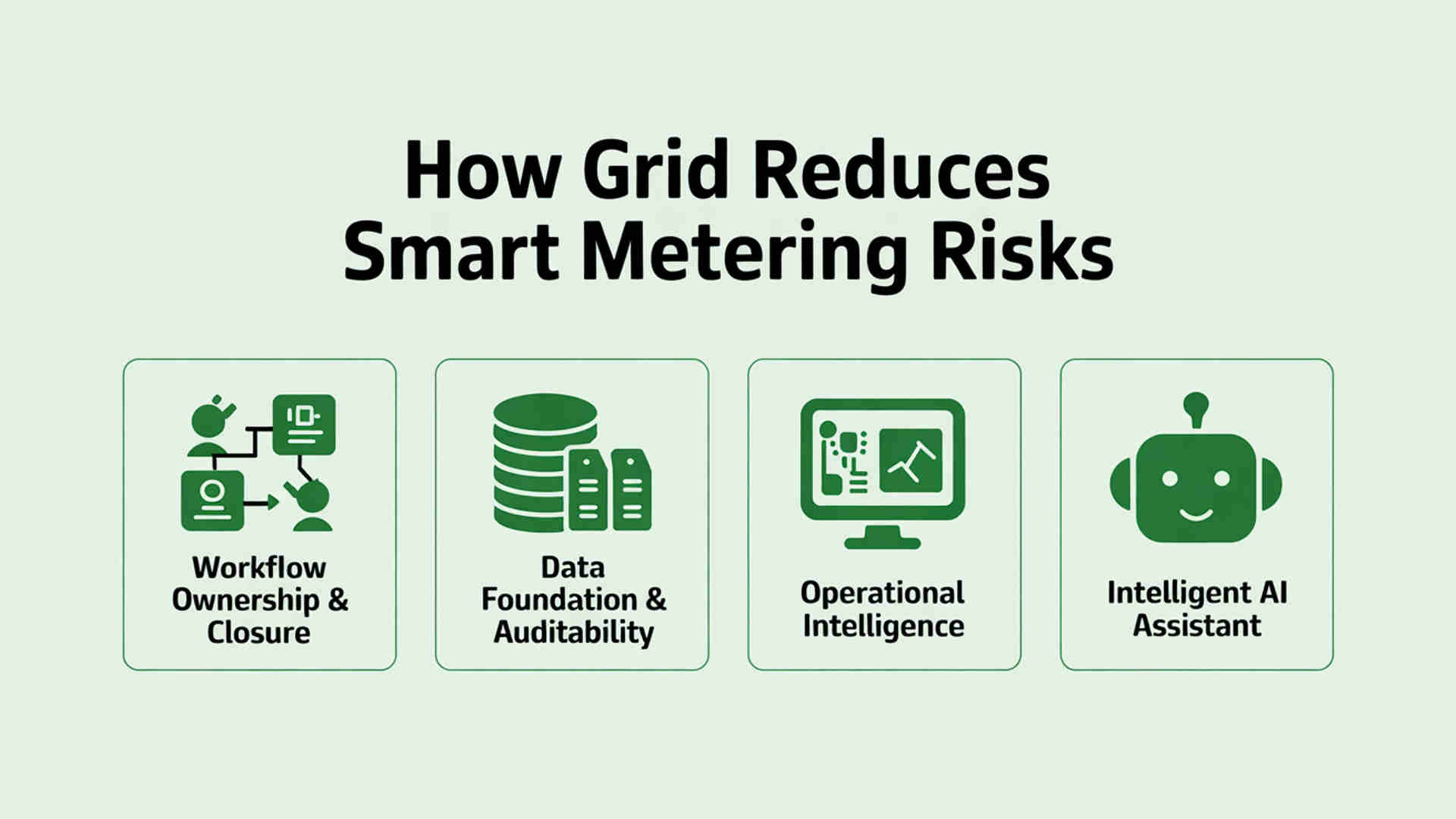
How Grid helps in reducing smart metering risks
Workflow ownership + closure (Grid Flow + GridOps)
In case of a surge in missing data reads, Grid auto-groups them based on feeder/contractor, routed to the right team with an SLA, and closed only after the system verifies read recovery. This ensures that exceptions don’t sit open across billing cycles.
Data foundations + auditability (Grid Vault)
When a meter is replaced or moved, Grid AI maintains the meter → premise → feeder mapping history. This helps keep reporting consistent and prove “what changed, when, and why” during audits or dispute reviews.
Operational intelligence (Grid SMOC)
With Grid’s SMOC (smart meter operations center) view, users can highlight repeat tamper flags and abnormal usage clusters in one zone. This enables supervisors to prioritize field visits where recovery is most likely instead of spreading crews thin.
Grid AI
Operators and field analysts may have questions like, “Why did complaints spike in Zone 3?”. In such cases, Grid AI detects patterns, and summarizes it (new installs + estimate-to-actual transition + missing-read pockets), and recommends it for next checks, so teams act faster with context.
Are smart meters worth it for utilities? A quick decision checklist
The true value of smart meters is realized when the data helps solve an operational or commercial problem, and not just a “modernization” tool. Utilities can use the below checklist to pressure-test readiness for smart meter installations within their AMI networks.
When it’s worth:
- Utilities want measurable improvements in billing accuracy, response time, loss investigation, etc, and teams are also ready to track them
- There are defined teams to build exception workflows, so that every anomaly moves from detection → ownership → closure, and not just dashboards → backlog
When it's risky:
- Data governance is weak within the AMI network, especially metadata completeness, mapping (meter-premise-feeder_ and lack of consistent definitions
- Teams across metering, IT, billing aren’t aligned on “what counts as an issue” and the issue needs to get resolved
Some key “ready/not ready” checklist points:
- Does the utility have clear KPIs tied to outcomes (not limited to activities)?
- Does every exception have defined owners and SLAs across teams?
- Is there a customer communication plan for rollout and billing transitions?
- Are there baseline measurements to prove “before vs after” comparisons?
Conclusion
Smart meters deliver utility-scale returns, but only when the AMI program is designed for execution beyond installation. If your utility is planning a rollout (or seeking to stabilize an existing one), the next critical step is to benchmark current readiness: data mapping, exception volume, closure discipline, and KPIs to measure program performance.
Connect with our team for more information, or a demo call, and they can walk you through that checklist and what “ROI-positive” smart metering would look like in your network.


-compresso.webp)