
.jpg)
The real challenge for utilities today no longer lies in collecting AMI data. It lies in making sure that network and metering data can actually help identify inefficiencies and optimize operations across teams and departments. When this data is reviewed too slowly or remains disconnected across systems, teams may gain visibility but still lose operational control.
That is why AI and machine learning are becoming more relevant to energy management. It can help teams process large volumes of metering and operational data faster, surface patterns that require attention, and streamline workflows that turn insight into action. At the same time, AI is also adding pressure to the power system itself. According to International Energy Agency research, global data-center electricity use may rise to around 945 TWh by 2030. An analysis by the Department of Energy also found that U.S. data centers represented about 4.4% of total electricity consumption in 2023.
This shift matters because AI can analyze large, continuous data streams much faster than manual reconciliation. By continuously ingesting new data and learning from patterns, it can detect unusual activity earlier and help trigger the next step based on defined utility workflows.
Why Has Energy Management Become Harder in Modern AMI Networks?
Driven by smart metering investments, modern AMI networks have undoubtedly improved visibility into energy consumption. At the same time, however, energy management has become more complex. Readings now arrive at intervals of 15–30 minutes, alongside data points tied to voltage signals, communication events, field updates, and more.
More data does not automatically translate into better use of energy or stronger operational control. It can create more dashboards, more widgets, more exceptions to investigate, and greater manual review across metering, billing, and field teams. The core issue is whether teams can quickly identify which events matter, understand the root causes, and decide what corrective actions should follow.
That is where AI energy usage becomes a worthwhile issue to evaluate. For utility leaders, AI becomes relevant when the network reaches a stage where manual review can no longer keep pace with the speed, frequency, and interdependence of modern utility metering networks.
How Does AI in Energy Make AMI Data More Usable?
Let’s consider a real-world scenario. A meter stops communicating, a usage pattern changes unexpectedly, and a billing exception appears soon after. Each of these signals may sit across different layers such as HES, MDM, billing, OMS, and workflow systems.
The utility has the data it needs, but teams still spend time piecing together what happened and who should respond. They also need clearer visibility into whether the issue points to a faulty device, a network problem, or an operational delay. This is where energy management begins to weaken—not because data is missing, but because interpretation and action are delayed.
AI systems can strengthen data management in smart energy metering networks by bringing related signals together across AMI and operational systems, so events are not reviewed in isolation. Energy AI tools can also compare these signals against historical trends, thresholds, and workflow logic to identify what is abnormal, what is connected, and what should be prioritized first.
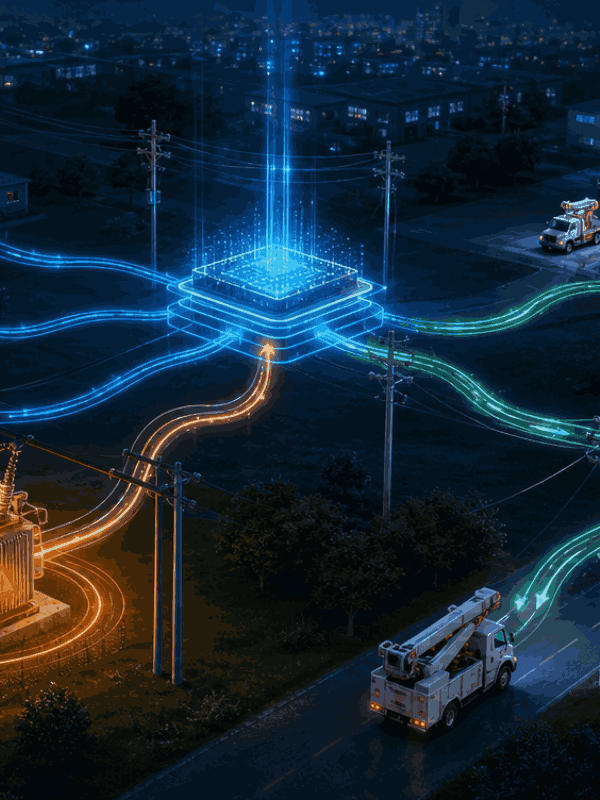
Solutions like Grid AI are designed to continuously learn from incoming data and events. Over time, they become more data-aware and intuitive, helping route the right issue to the right team, recommend next steps, and trigger the appropriate workflows. Simply put, AI helps utilities move from scattered data and delayed review to coordinated response and more consistent operational follow-through.
How Does AI Improve Energy Management for Utilities?
The value of AI in energy utilities begins with speed. Traditionally, analysts had to move manually across systems such as MDM, billing, OMS, GIS, and workflow tools to make sense of the data flowing through the network. By contrast, AI tools can be configured to automatically read large volumes of data, connect related signals, and return answers in plain language.
For example, Grid AI is built around a simple operating model: ask, analyze, and act. Teams can query data in natural language, receive explainable outputs, and trigger actions across systems rather than stopping at isolated analytics.
This kind of framework matters because effective energy management depends on more than better visibility. It depends on knowing which exception should be handled first, which pattern points to a deeper issue, and which team should act next.
Modern AI solutions for utility data management should improve how utilities interpret, connect, and act on AMI data. Their role is not limited to analysis alone. They must also help teams move from detection to response in a more structured way.
Ideally, AI utility platforms should be able to:
- Detect anomalies and potential theft patterns by analyzing interval consumption data, event histories, and tamper signals
- Support predictive maintenance by evaluating event frequency, asset behavior, and network relationships
- Speed up investigations by connecting relevant data across systems and reducing the time needed to understand what happened
- Generate reports, route workflows, and support controlled action paths such as review, approval, and execution
This is what makes AI relevant to modern utility operations. It strengthens decision support and workflow coordination rather than functioning as a black-box automation layer.
What Operational Value Does AI Create in Energy Management?
The real value of AI in energy management appears across three areas: earlier detection, stronger operational awareness, and faster follow-through.
Faster issue detection and prioritization
AI utility solutions should help operators identify issues such as abnormal consumption, tamper signals, non-communication risks, and loss-related exceptions. An ideal platform compares interval data, event logs, and baselines against known patterns. This significantly reduces the time otherwise spent deciding which issues need immediate attention before they escalate into more serious problems.
Improved forecasting and operational awareness
The value of AI in energy management increases when it helps utilities improve forward visibility, not just retrospective analysis. Capabilities such as transformer risk forecasting, device baselining, and topology-aware pattern recognition help anticipate how asset behavior, outage signals, and meter performance may change over time. This gives teams a stronger foundation for better planning and clearer operational visibility across the network.
Faster movement from insight to action
AI creates the most value when it allows utilities not only to analyze, but also to act. Features such as natural-language investigation, auto-generated reports, explainable recommendations, inspection-ready alerts, and controlled action flows reduce manual effort and direct the next step to the right team more quickly. This is where AI energy solutions become easier to justify, because the return is tied to faster response, better coordination, and stronger energy management.
Can Renewables Help Meet Rising AI-Related Electricity Demand?
Yes, renewables will play a major role, but they are not the whole answer. IEA analysis states that renewables already meet half of the global growth in data-center electricity demand. Renewables are also expected to supply more than 450 tWh of additional electricity for data centers by 2035. This growth is being driven by shorter project timelines, lower costs, and strong clean-energy procurement commitments from major tech companies.
This matters for utilities because it highlights the growing role of solar and wind in meeting rising AI consumption and broader AI energy usage.
At the same time, renewables alone are not expected to solve the AI energy usage challenge. The analysis also notes that dispatchable sources and natural gas will still matter, while the tech sector is also helping accelerate newer nuclear and geothermal technologies.
It is increasingly important for energy companies to invest in these initiatives to meet rising demand, especially as queries on AI models like ChatGPT can require nearly 10 times the energy of a conventional Google search. For utilities, rising AI energy consumption can no longer be viewed only as a technology trend. It is becoming a real planning issue that connects new load growth with generation mix, storage readiness, and grid flexibility. The stronger leadership response is not to treat AI power consumption as a standalone issue, but to prepare the system for a more electricity-intensive digital economy.
Conclusion: Can AI’s Energy Cost Be Justified by the Operational Value It Creates?
For modern utilities, the more relevant question is not simply how much power AI consumes. It is whether investment in AI for energy utility management can help turn growing volumes of interval data, alarms, and operational events into one more consistent and manageable AMI network flow.
If AI can help detect anomalies faster, interpret network signals earlier, and move utilities more effectively from visibility to action, then its value becomes not just theoretical, but operational.
For leaders looking to turn AMI data into faster decisions, quicker follow-through, and clearer operational visibility, it helps to see how AI models work across real utility workflows. Connect with the Grid team to explore how AI can support that transition across systems without adding more complexity.

.png)
.png)


