
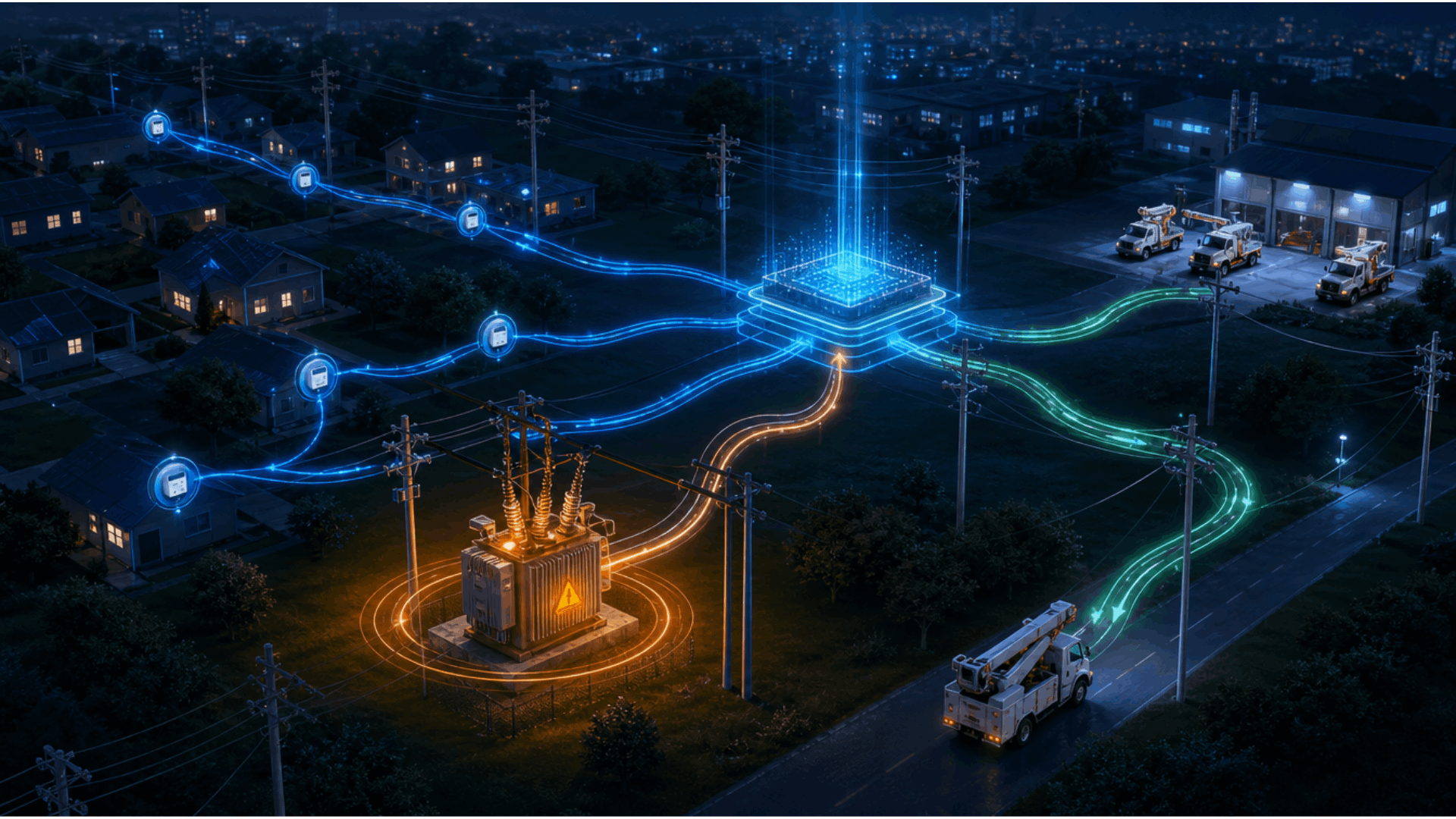
Meeting global electricity demand through 2030 will require annual grid investment to rise by about 50% from today’s USD 400 billion, according to the International Energy Agency Electricity 2026 report. This makes protecting existing assets and reducing maintenance delays more important for electricity distribution companies (DISCOMs).
Advanced Metering Infrastructure (AMI) transformer analytics can identify sustained loading, voltage imbalance, repeated interruptions and missing meter data. These insights support transformer voltage monitoring, but they are reliable only when readings are complete and each meter is mapped to the correct transformer and phase.
Once a transformer is flagged, the DISCOM needs to send the transformer ID, location, and supporting readings to the responsible team with a response deadline. Recording the field result and reviewing later AMI readings allows leaders to track open work, confirm whether the action worked and identify recurring issues.
What should happen after AMI identifies a transformer risk
The first operational output should be one traceable case linked to the correct transformer. It should state what happened, how reliable the evidence is, who must act and when the response is due.
The asset needs to be correctly identified before assigning the work
A cluster of abnormal meter readings is useful only when the utility can connect those meters to the same transformer and, where relevant, the correct phase. The case should carry the transformer ID, rating, feeder, substation and Geographic Information System (GIS) location before it reaches maintenance.
Stale mapping can send a team to the wrong asset or make a local condition appear broader than it is. A failed mapping check should therefore send the case to AMI or data operations for correction before a field instruction is issued.
Give field crews clear information about the transformer issue
Consider a case where during seven evening peaks, phase mapped meters show a recurring voltage imbalance around one transformer. The readings are complete, the asset association is current, and the same consumer group is affected each time.
The utility can open one transformer case, attach the relevant readings and location, apply the response time in its operating policy and send the issue to distribution maintenance. The crew records its finding and approves corrective work in the field system. AMI readings from comparable evening periods then show whether the condition continues.
The same operating chain applies to sustained loading concerns, repeated low voltage, interruption clusters and persistent data gaps.
Where transformer alerts lose time
Most delays occur between identifying the issue and assigning the response. The information required to act often remains spread across different systems and teams.
- Information remains across separate systems: HES and MDM hold the event and meter readings, GIS and asset systems hold the transformer details, and Workforce Management (WFM) holds the work status. Teams must bring this information together before assigning the issue.
- One transformer can generate several alerts: Separate meter events can create duplicate assignments or prevent teams from recognising the common transformer behind them.
- Manual handoffs break the record: Email, spreadsheets and calls may move the alert, but ownership, evidence and response status can become separated during the handoff.
- A completed visit does not confirm resolution: The work record must include the field finding and action taken. Later AMI readings are still needed to confirm whether the condition improved or requires another response.
What information must travel with the alert before the work is assigned
The receiving team needs a compact operational record that answers five questions: which asset, what condition, how reliable, who owns it and what completes the case.
.png)
The field team needs a concise explanation of the condition and enough evidence to begin the approved inspection. Planning teams need the retained case history when repeated conditions point to load redistribution, augmentation or replacement.
Which team should own each transformer issue?
Responsibility should follow the nature of the issue, the quality of the data and the work required. The DISCOM's operating policy should define the receiving function for each condition.
- Data or mapping problem: The AMI or data operations team checks missing intervals, uncertain meter associations and outdated asset mapping before fieldwork begins.
- Confirmed network condition: Distribution maintenance receives an inspection request with reliable readings, transformer details and location data.
- Recurring capacity concern: Maintenance and network planning review the demand pattern, previous field findings and options for load redistribution or network augmentation.
- Interruption cluster: When meters supplied by the same transformer report interruptions, the control room or maintenance team receives the issue according to the utility’s restoration procedure.
The routing decision should identify the responsible function rather than assume a specific technician. The workforce system can then select and schedule the crew according to location, availability, skills and safety requirements.
What measures should DISCOM take to expose response delays and repeat risks
DISCOM leaders need to know how quickly a confirmed issue reaches the responsible team, whether the work is completed on time and whether the same condition returns. A small set of measures can provide this view.
- Time From Confirmation to Acceptance: Measure the time between confirming the transformer risk and its acceptance by the responsible team. Record every reassignment and its reason to identify delays caused by incorrect ownership, missing asset information or insufficient evidence.
- Completion Against the Response Time: Track how many cases are accepted and completed within the response time set by the utility. Also count confirmed events that never reached an owner or remained incomplete after the deadline.
- Recurrence After Closure: Track whether the same transformer produces the same condition after the case is closed. A repeated event should prompt a review of the field findings, the action taken and whether further maintenance or planning intervention is required.
Together, these measures show whether delays come from incomplete data, incorrect routing, limited field capacity, pending approvals or unavailable materials. The case history also gives Operations and Maintenance (O&M) and capital planning teams the evidence needed to decide the next action.
How Grid Flow carries the event into operations
WorkOnGrid addresses this operational gap through Grid Flow. The platform connects smart meter sources with systems such as the HES, MDM, billing, Customer Relationship Management (CRM) and WFM.
When an event enters Grid Flow, the utility’s configured rules can check the available data, add relevant context, determine the next step and send the result to the appropriate system or team. Grid Flow also provides visibility into how the workflow is running, where it has failed and how response targets are being met.
In the recurring voltage imbalance example, the DISCOM could configure a flow to check the available transformer and mapping data before routing the event. Where the asset association is reliable, the event could be enriched with the transformer ID and location and sent to distribution maintenance. Where the mapping check fails, the workflow could direct it to data operations for validation.
DISCOM teams define the event criteria, routing rules, responsible teams, notifications and escalation paths. Grid Flow applies that workflow consistently and records how each event moved through it.
Talk to our team about how Grid Flow can help your teams route transformer issues to the right owners, track response performance and maintain visibility from detection through closure.

.png)
.png)
.png)


