.jpg)
Real-time, utility-grade smart energy monitoring is quickly replacing traditional, retrospective energy monitoring in utilities. Due to structural changes across the grid in recent years, this transition is no longer optional.
Distribution networks load behavior is changing as a result of increased electrification and DER adoption. Nearly 30% of evaluated distribution transformers are currently operating in an overloaded state, and recurrent loading exceeding 125–150% capacity greatly increases the risk of aging and failure, according to NREL research. The study also concludes that overload prevention is becoming a priority rather than a planning exercise for utilities due to 2-year replacement lead times and 4–9x increase in costs.
At the same time, global DER adoption continues to surge. A Precedence Research study highlights that Grid-tied systems account for nearly 60% of installations in the distributed energy resources industry. The global DER market is expected to grow from USD 86.95 billion in 2024 to USD 293.59 billion by 2034. Although this is beneficial, it creates key operational hindrances:
- Transformer stress and voltage profile instability caused by reverse power flows
- Increased volatility and forecasting difficulty
- New threats to coordination and protection between substations and feeders
At the same time, these existing pressures get compounded by other utility macro trends:
- AMI growth, generating billions of high-frequency data points
- Weather-driven outage volatility and extreme events
- Rising peak demand from data centers, heat pumps, and EVs
- More stringent regulations pertaining to grid resilience and dependability
When taken as a whole, these factors make one thing crystal clear. Consumer-grade IoT energy monitoring cannot satisfy utility-scale operational requirements.
Utilities need a framework for intelligent energy monitoring that can:
- Convert SCADA and AMI data into operational intelligence in real time
- Detect events like overloads, imbalances, reversal flows, and abnormalities early on
- Connect energy events to asset conditions and field operations.
- Encourage outage prevention, regulatory preparedness, and proactive planning.
For utility executives, real-time AMI monitoring forms the foundation for dependability, resilience, and contemporary grid decision-making, not just visibility.
What Does Smart Energy Monitoring Actually Mean in a Utility Context?
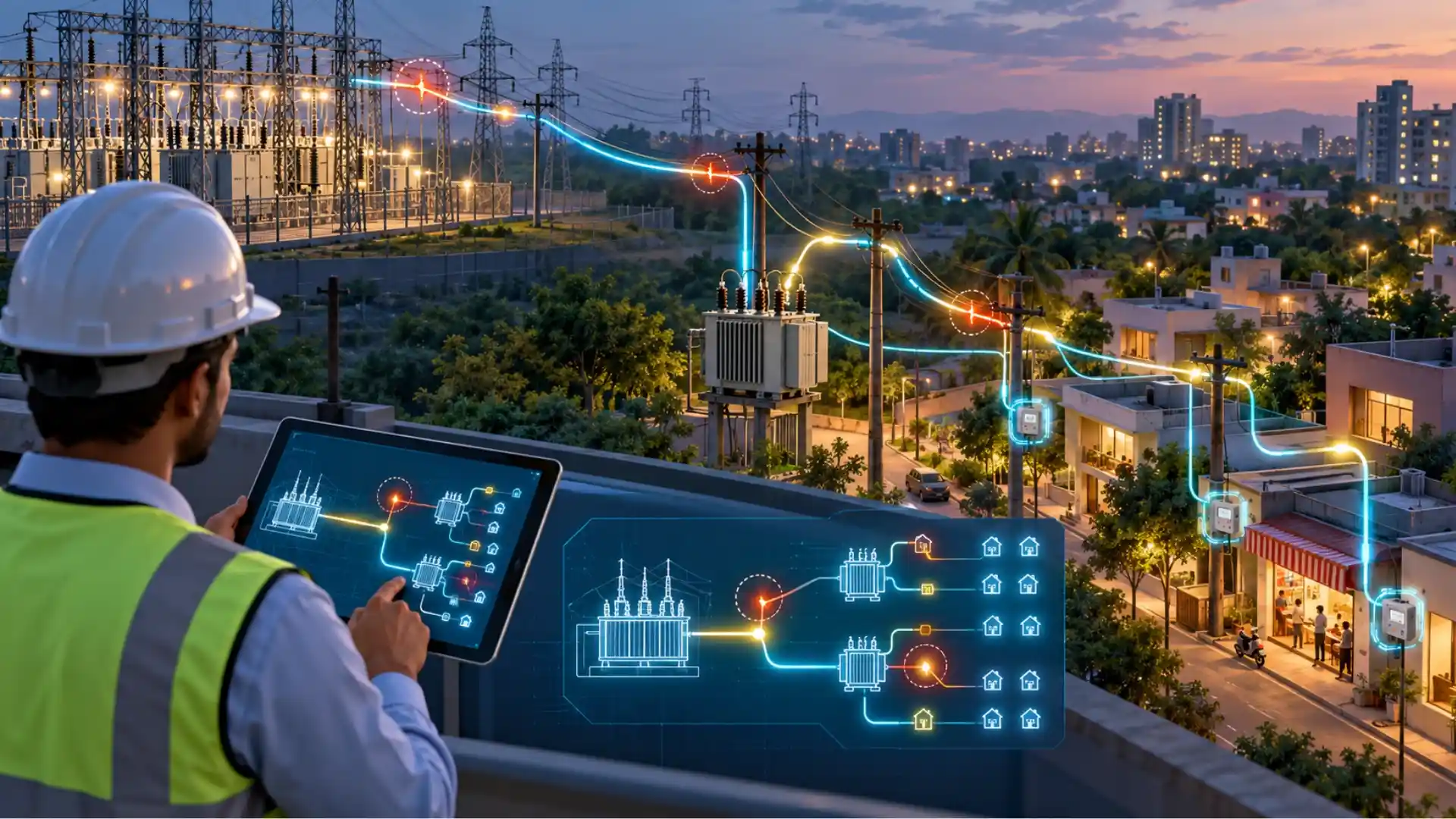
For utilities, the meaning of energy monitoring changes when compared to consumer-grade monitoring in homes or commercial complexes. It refers to a real-time operational intelligence framework. One that integrates utility systems (AMI, SCADA, GIS, MDM), DER telemetry, network-level power flow, etc, into a unified coordinated decision layer.
Key distinctions between energy monitoring systems designed for consumers and large-scale grid operations include:
What is the Real Scope of Smart Energy Monitoring for Utilities?
By its very nature, utility-scale energy monitoring is a network-centric framework rather than being device-centric. The model makes it possible for large enterprises to comprehend and respond to situations across the grid network.
1. Distributed networks, meters, transformers, and feeders
Executives gain access and visibility into:
- Feeder loading and imbalances
- Overload patterns and thermal stress in transformers
- Reverse energy flows or patterns in DER-driven initiatives
- Abnormal energy consumption at smart meter and segment levels
Such detailed insights enable utilities to enhance their grid management initiatives, planning capacity, asset replacement strategies, etc.
2. Integrated Telemetry (AMI+SCADA+IoT)
The operational reality of any utility is dispersed across various systems. Effective monitoring brings together:
- AMI interval data (power quality, voltage, and load)
- SCADA telemetry (substation performance, feeder switching, and breaker status)
- IoT sensors for multi-utility situations (transformer temperature, line voltage, pressure/flow)
Utilities eventually establish a single operational truth rather than separate signals when these components are merged together.
3. High-Frequency Real-Time Operational Data
A utility-grade energy monitoring system must handle:
- Millions of data points every single hour
- Incoming data at intervals of 30-mins or even 15-mins intervals
- SCADA event data in under a second
- Fluctuations in DER output data
- Variability due to changes in weather
These capabilities are essential in utilities for early detection of grid instability, something which consumer-centric energy monitoring models are not designed to achieve.
Why is Real-Time Intelligence Now a Strategic Utility Requirement?
Post-facto load evaluations and monthly energy summaries are no longer sufficient for modern utilities. The operational and financial risks of not implementing real-time smart energy monitoring have increased dramatically. A recent industry example demonstrates this shift.
In 2025, Spain experienced a statewide blackout due to severe weather and grid instability. The event affected millions of people and demonstrated the negative effects of inadequate system visibility. Industry analysts caution that if utilities continue to use retrospective monitoring frameworks, similar instances may occur even in the US. Events like DER saturation, thermal stress on transformers, and weather-driven load spikes could pose a threat to grid networks.
This event highlights an unavoidable reality: real-time energy intelligence is now a necessity for frontline operations and not an analytical luxury.
What are the Operational Challenges Utilities Face Without Smart Energy Monitoring?
Real-time energy intelligence is no longer optional in today’s complex AMI ecosystems. However, a lot of utilities continue to use fragmented or retrospective monitoring models. As a result, utility grid operators lose the situational awareness necessary to maintain dependability and control costs. This also impacts their ability to make informed decisions when AMI, SCADA, GIS, OMS, and DER telemetry do not communicate with one another.
In this section, we will explore the operational difficulties that occur when utilities lack a uniform smart energy monitoring layer.
Data fragmentation and silos across systems (AMI, SCADA, GIS, OMS, Billing)
Every year, a standard enterprise utility produces billions of data points. But, in the absence of a unified operational view, this data may prove to be more detrimental than beneficial to the company.
Some key operational breakdowns include:
- Millions of data points with no common interpretation
- AMI provides interval data, GIS provides network topology, and CIS highlights billing details. Yet, most of these datasets rarely converge, given the fragmented nature of utility networks.
- As a result, operators in boardrooms and in the field may struggle to correlate spikes to feeder stress, asset degradation or voltage events.
- No correlation between transformer loads, outage signals and consumer experience
- In siloed ecosystems, all of the above data points may appear as unrelated events. However, transformer performance can severely affect customer behavior and can also help detect potential outage signals via robust analysis.
- This leads to longer maintenance or diagnosis cycles, higher O&M costs and sometimes, unnecessary truck rolls.
Business Impact: Misaligned infrastructure upgrades, ineffective planning choices, cost overruns, and rising customer dissatisfaction as a result of delayed root-cause analysis.
Unreliable or Slow Identification of Anomalies
In the absence of real-time smart energy monitoring, utilities frequently fail to identify grid anomalies until assets are already under stress or customers are impacted. Rather than using early warning signals, legacy monitoring frameworks are usually reactive, depending on alerts set off by malfunctions.
Some major operational failures include:
- Overloads discovered too late to prevent damage
- Until temperature thresholds are surpassed or failures take place, transformer and feeder overloading frequently goes unnoticed. Without continuous load visibility, utilities are unable to take action during early stress windows.
- As a result, assets age more quickly, lose insulation, and have a shorter useful life.
- Voltage and phase imbalances remain unaddressed
- Phase imbalance and voltage instability often appear gradually over feeders and low-voltage networks. Operators are unaware of these problems in the absence of high-frequency monitoring.
- This leads to increased technical losses, lowered power quality, and can also degrade metering equipment located at the client's location.
- Hidden technical losses accumulating across the network
- Unbalanced loads, transformer inefficiencies, and line losses accumulate over time without being noticed.
- Eventually, utilities pay for energy that never reaches consumers since with no clear attribution or corrective framework.
Business Impact: Reduced asset lifespans, increased O&M costs, a higher likelihood of outages, deteriorated power quality measures, and increase in customer complaints.
Inaccurate Forecasting During Peak Demand
Load patterns in current ecosystems tend to be more dynamic. Legacy forecasting models that rely simply on historical data or monthly billing struggle to keep track of real-time development and events.
Some key operational breakdowns include:
- Load spikes caused by EVs remain hard to predict accurately
- Residential EV charging results in localized, time-bound peaks which legacy solutions often struggle to model accurately.
- The utilities’ inability to predict stress at feeder or transformer levels increases the chance of overload risk.
- Demand volatility caused by the weather overwhelms planning models
- In modern AMI, extreme temperatures can change load profiles in a matter of hours.
- Without real-time energy monitoring, utilities often tend to underestimate demand surges and depend on emergency responses.
- Data center growth distorts demand planning
- Data centers draw large amounts of power continuously, unlike most residential or commercial customers whose usage fluctuates. This steady, high load makes past demand patterns less reliable.
- Without clear, real-time visibility, utilities risk underbuilding capacity in high-growth areas or investing too early in locations where demand does not materialize as expected.
Business Impact: Unplanned infrastructure upgrades, inefficient resource and capital allocation, emergency procurement costs, etc.
Growing DER Penetration and Reverse Power Flow Risks
Multiple regions in the US and Canada now mandate net metering, with DER (distributed energy resources) initiatives resulting in 7.2 GW in distributed battery storage. This increased expansion of DER in the last few years has fundamentally altered how the grid behaves and functions. Without a smart AMI monitoring framework, it becomes a steep task for utilities to manage bidirectional energy flows smoothly.
Some major operational breakdowns include:
- Backfeeding into transformers remains unregulated
- Reverse power flows push transformers past their design limitations, often causing heat and mechanical stress.
- These issues frequently go undiagnosed until a failure or protective trip occurs.
- Voltage instability increases at the edge of the grid
- High DER penetration tends to cause overvoltage, flicker, and fast voltage swings, particularly during low load periods.
- Without real-time monitoring of the AMI, utilities cannot ensure voltage compliance or stability.
- Billing and reverse-flow reconciliation breaks down
- Legacy billing and metering systems make it difficult to appropriately reconcile bidirectional energy flows.
- This causes income leakage, consumer conflicts, and compliance issues.
Business impact: Reduced grid reliability, increased asset replacement costs, regulatory vulnerability, and ambiguity around DER program economics.
Compliance Gaps and Reliability Exposure
Regulatory norms and expectations now extend beyond business outcomes. Organizations must provide process transparency and ensure operational traceability. Utilities still relying on legacy tools for energy monitoring are bound to fall short of these criteria.
Core operational breakdowns include:
- Inadequate reporting and traceability
- Utility companies struggle to provide timestamped, event-level documentation for audits and inquiries.
- Manual reconciliation often creates delays and reporting inaccuracies.
- Weak audit trails for decision making
- Without consistent data logs, utilities may struggle to adequately explain why specific actions were taken during grid events.
- This weakens the organization’s governance and regulatory confidence.
- Reliability metrics decline silently
- Slow detection of anomalies and ineffective response increase SAIDI and SAIFI with time.
- Utilities keep relying on operational workflows that respond to penalties rather than prevent them.
Business impact: Increased regulatory scrutiny, fines, rate case challenges, and decreased public and stakeholder trust.
How does Smart Energy Monitoring Work for Modern Utilities?
When selecting a utility management solution for energy monitoring, leaders must view it as a set of tools or dashboards. It works as an end-to-end operational architecture, connecting raw metering data to real-world decisions, applicable across departments (finance, field ops, compliance).
Modern utilities need to implement this smart energy monitoring architecture as an additional layer above their existing systems. Each layer will play a critical role in transforming raw data into operational outcomes.
Data Ingestion Layer: Capturing Grid Signals at Scale
Solutions that ingest high-volume, high-frequency data across the AMI network without delay form the foundation for smart energy monitoring.
Key data points captured during this stage include:
AMI interval data
Energy, voltage, and load readings are taken at 15, 30, and 60-minute intervals, with cadence monitoring to detect silent or stale meters.
SCADA telemetry
Voltage, current, frequency, breaker status, and switching events are all measured at the substation and feeder levels, and they frequently arrive in sub-second intervals.
IoT and edge sensors
Transformer temperature, line voltage, feeder load, or multi-utility sensors provide additional operating context beyond meters.
GIS and asset metadata
Network topology, asset hierarchy, phase connection, and location intelligence are all necessary to contextualize energy occurrences.
Why this matters for utility leaders: Without a centralized ingestion layer to capture data coming from multiple sources, operational visibility will remain partial. Therefore, decisions are late not because data does not arrive sooner, but rather because they remain fragmented.
Data Normalization and Validation: Ensuring Data is Trustworthy
Your raw data ingested from utility systems is rarely analysis-ready. Factors like variances in data formats, quality or cadence can severely distort insights if not addressed properly.
A robust energy monitoring system ensures raw data becomes governance-ready via:
Data cleansing and standardization
Aligning data units, timestamps, and formats in AMI, SCADA, and sensor feeds.
VEE (Validation, Estimation, and Editing)
Identifying gaps, estimating missing intervals, and correcting outliers without affecting real grid events.
Rules-based anomaly validation
Differentiating between genuine operational concerns (such as overloads or phase imbalances) and data noise or transmission mistakes.
Why this matters for utility leaders: Executives gain confidence during actions such as asset upgrades or outage prevention. They are supported by auditable data, and not based on assumptions.
Real-Time Energy Intelligence: From Data Signals to Insights
Once the data is validated, this layer transforms it into actionable insights via continuous analysis of grid behavior.
Some of the core analytical capabilities in this stage are:
Transformer overload prediction
Identifying persistent or repeated overload patterns before thermal limits are exceeded.
Voltage and phase imbalance detection
Tracking gradual degradation of data, which raises technical losses and accelerates asset aging.
Load curve and peak behavior analysis
Understanding how EV charging, data centers, weather, and DERs affect energy demand at the feeder and transformer level.
Reverse power flow and backfeed detection
Monitoring DER-driven flows that tend to challenge standard protection and charging approaches.
Meter health and energy drop correlation
Consumption anomalies are linked with meter performance or communication issues to minimize false assumptions.
Why this matters for utility leaders: This information transforms utilities to shift from reactive to predictive control, lowering emergency costs and increasing asset utilization.
Workflow Orchestration Layer: Transforming Insight into Action
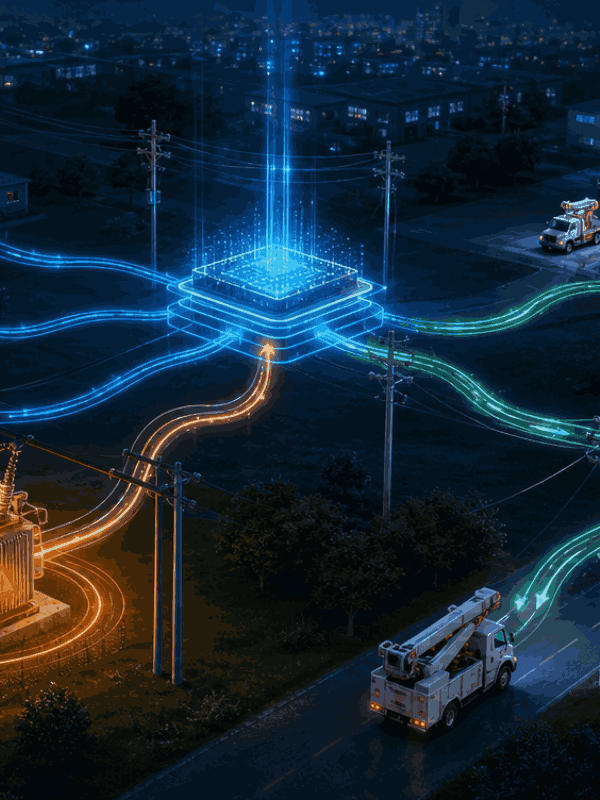
Insights gained from raw data deliver true value when they empower right decision making at the right time. Energy monitoring layers in AMI embed workflow orchestration layers to ensure utilities can address potential issues systematically.
Automated alerts
This event is triggered when overload, voltage deviation, or loss criteria are exceeded.
Auto-routing to field or operations teams
Tasks are routed and assigned based on geography, asset criticality, severity, etc., instead of manual assumptions.
SLA and response tracking
Ensuring energy-related events are resolved within operational and regulatory timescales.
Compliance-driven workflows
Automatically documenting actions for auditing and reporting purposes.
Why this matters for utilities: By reducing reliance on manual coordination, utilities improve operational efficiency, reduce response cycles and preserve institutional knowledge even when experienced professionals retire.
Real-Time Dashboarding and Operational Visibility: Data-Backed Decisions
For clear and precise decision making, utility personnel need role-based visibility, not raw data streams. This layer must offer:
- Energy and load insights at feeder levels
- Identifying transformer hotspots (highest temperature areas)
- Consumption metrics and load profiles
- Visibility into technical losses across zones and feeders
Why this matters for utility leaders: With these insights, utilities can prioritize investments, postpone unnecessary upgrades and make decisions with greater confidence.
Reporting and regulatory readiness: Built-in and not bolted-in
Regulatory and governance are becoming more strict, demanding traceability and verification of utility data rather than mere summaries.
A modern AMI energy monitoring system architecture supports:
- Automated regulatory reporting
- Audit-ready, timestamped logs
- Compliance analytics related to real-life grid occurrences
- Historical reconstruction of decisions and actions
What this means for utility leaders: Utilities can ensure regulatory adherence becomes a by-product of every day operations, and not just an annual scramble during audits.
When smart energy monitoring is integrated as a unified architecture, utilities gain far more than mere data visibility. They achieve operational control, financial predictability, and regulatory confidence.
In our next section, we explore how these capabilities translate into measurable business results such as reliability, cost control, asset life extension, and customer satisfaction.
Real-Life Use Cases: How Does Smart Energy Monitoring Create Operational Value for Utilities?
The true impact of integrating a smarter approach to energy monitoring is realized when it begins to upgrade day-to-day operations. So, what does this actually mean for utilities? This should translate into fewer truck rolls in case of emergencies, predicting maintenance needs, lesser surprises within the AMI network and improved capex decisions.
When real-time SCADA and AMI data are turned into operational intelligence, utilities are able to:
- Gain insights on how EVs, data centers, DERs and weather shape local load
- View data related to feeder imbalance or transformer stress/overvoltage/undervoltage before failure occurs
- Reduce revenue loss by detecting leakage, diversion and metering events early on
- Provide field ops and back office control rooms a unified and real-time view of overall grid health
In this section, we will highlight the real-life applications of smart energy monitoring for modern utilities; the ones that matter most to utility executives and leaders.
Transformer load monitoring and overload protection
In the majority of utilities, distribution transformers silently endure increasing stress from EVs, DERs, and newly connected loads. With high-end energy monitoring in AMI, utilities can ensure that every single asset within the network is continuously under observation.
What does it achieve operationally?
- Monitors transformer loads at 15-60 minute intervals, including thermal stress trends.
- Flags repeated loading exceeding safe thresholds well before nameplate limitations are reached.
- Correlates load patterns with time of day, EV charging clusters and local weather patterns.
Why does it matter for utilities?
- Preventing failures instead of a replacement reaction: Real-time network monitoring allows utilities to reconfigure feeders, or shift load before a potential catastrophic failure (such as insulation breakdown).
- Extending asset lifespan: Adding a few years of life to utility assets has a compounding effect across a large transformer fleet.
- Reducing truck rolls: AMI data ensures that planned interventions minimize after-hour emergency calls, saving resources and costs.
Energy insights at feeder levels
Feeder level is where utilities can specifically identify hidden inefficiencies across their network.
What does it achieve operationally?
- Compares energy injected at the feeder head to total smart meter consumption over predefined intervals.
- Detects abnormal technical losses by segment, phase, or time band.
- Identifies unexpected load dips during faults or outages, even before customer complaints arrive.
Why does it matter for utilities?
- Managing technical losses: Rather than addressing loss as a single percentage at the system level, utilities can identify problem areas and prioritize reconductoring, capacitor placement, or voltage optimization.
- Identifying unauthorized consumption: Persistent mismatches between feeder injections and billed usage help detect probable theft spots or unmetered loads.
- Optimizing restoration service: Sudden load disappearance on a specific branch narrows down fault locations, reducing patrol time and improving restoration performance.
Feeder-level balancing changes the utility approach from "we think we're losing energy somewhere" to "we know which segment, when, and at what scale."
Monitoring DER Impact
As DER penetration increases, the impact cannot be merely addressed using monthly net-metering summary. With real-time smart energy monitoring, operators can transform DER from an accounting problem to an operationally evident resource.
What does it achieve operationally?
- Monitors export flows from rooftop solar or other DERs at the meter and segment levels.
- Detects reverse power flows to transformers and upstream feeders.
- Tracks voltage fluctuations, flicker, and rapid swings caused by variable renewable energy.
- Combines DER output patterns with traditional generation and load to determine local hosting capability.
Why does it matter for utilities?
- Ensuring grid safety and protection: Reverse flows that push equipment beyond design assumptions are detected early, before they cause potential damage or accelerated aging.
- Improving DER program design: Utilities can update interconnection rules, incentives, and hosting limitations based on actual performance rather than assumptions.
- Enhancing customer experience: Customers will experience fewer nuisance trips, voltage complaints, and inexplicable inverter shutdowns.
Instead of perceiving DER as a threat to stability, utilities with advanced monitoring can approach it as a manageable, visible component of their energy mix.
Consumption profiles for forecasting and tariff validation
Energy monitoring framework provides a more granular view of how different client categories consume energy in real time.
What does it achieve operationally?
- Creates load profiles at the customer, segment, feeder, and substation levels based on seasonal and event conditions.
- Identifies genuine peak windows, ramp rates, and diversity factors for residential, commercial, and industrial loads (EV fleets, data centers, etc.).
- Compares observed consumption patterns to tariff design, demand charges, and programmed demand response events.
Why does it matter for utilities?
- Improving forecasting accuracy: Grid planners can move beyond static curves to profiles that account for DER, EV adoption, and recent weather extremes.
- Validating tariffs and programs: Measured behavior is used instead of enrollment numbers, which is leveraged for analyzing demand response, time-of-use rates, and important peak pricing.
- Facilitating smarter capacity planning: Investments in feeders, substations, and transformers can be sequenced according to actual utilization and risk, reducing stranded or prematurely deployed assets.
For utility leaders, this creates a shift in planning discussions from ‘assumed load growth’ to ‘proven consumption behavior’ supported by operational data.
Energy theft and revenue protection
For large utilities, events like meter bypass, energy diversion or unregistered loads tend to be hidden inside aggregated losses. By monitoring energy flow across the AMI, suspicions can be turned into actionable signals.
What does it achieve operationally?
- Tracks mismatches between projected load (based on connected capacity or past usage) and actual meter consumption .
- Detects and flags abnormal patterns, like rapid decreases in recorded usage while feeder or nearby consumption remains steady.
- Identifies abnormal flows, which could indicate unlawful connections, backfeeding from unauthorized generation, or modified equipment.
Why does it matter for utilities?
Improving revenue protection: Even a small percentage of non-technical losses can have a big impact on the bottom line in high-loss networks.
Ensuring fairness to compliant customers: When theft is recognized and treated systematically, honest customers are less likely to subsidize it.
Fostering regulatory credibility: Proactively controlling non-technical losses boosts regulators' confidence and facilitates tariff discussions.
When properly implemented, revenue protection through smart monitoring becomes a continual process, rather than a one-time crackdown.
AMI health and communication-based energy insights
In many utilities, ‘low consumption’ is often interpreted as a consumer or billing issue. The underlying cause, however, tends to be related to meter health or communication failure. Real-time energy monitoring bridges this gap by connecting energy patterns to AMI performance signals, allowing teams to focus on the right problem the first time.
What does it achieve operationally?
- Flags silent meters, stale intervals and irregular reporting cadences before they translate into billing exceptions.
- Distinguishes genuine load drops from data dropouts by comparing feeder/neighbor patterns to the particular meter's communication health.
- Links frequent read failures to specific assets, routes, or network zones allows for targeted actions rather than assumptions.
- Reduces ‘false alarms’ by comparing anomalies to device status (battery, last-gasp, tamper events, communication quality) wherever available.
Why does it matter for utilities?
Lesser billing disputes: Problems related to missing reads and estimated readings are minimized when communication hindrances are tracked early.
Reduced operational burden: Back-office utility teams spend less time reconciling disputes manually.
Cleaner data inputs: Forecasting, planning and loss analysis becomes a much more improved, transparent process with utilities able to trust underlying metering data.
Enhanced customer experience: Less unexpected bills, fewer return visits, and faster response when consumers report problems.
By connecting data across dispersed utility systems, executives can improve data dependability, leading to improved operational decisions. This is because utilities now stop reacting to ‘false’ or ‘estimated’ metrics, and can instead address the root causes of data failures.
The use cases that we explored above highlight how real-time insight and intelligence reduce outages, protect revenue, extend asset lifespan, improve customer trust, and more. In the next section, we explain what this shift towards smart energy monitoring means at a strategic level, and what awaits the future of utilities.
Conclusion: What does the Future of Smart Energy Monitoring Look Like?
In the upcoming decade, the future of utilities will be decided by how seamlessly they connect AMI 2.0, DER growth and asset intelligence into a unified operational framework. Smart energy monitoring sits at the center of this strategic shift, not just a ‘nice-to-have’ dashboard but as foundational to predictive utility operations.
Utilities that are able to realize the true value of AMI monitoring network will be able to:
- Extend asset lifespan, like transformers instead of chasing failures
- Keep SAIDI/SAIFI performance in check as DERs and EVs continue to scale
- Ensure revenue protection by transforming ‘suspicious patterns’ into ‘structured data’ for targeted investigations
- Strengthen regulatory adherence via end-to-end data lineage and traceability
- Frame plans with evidence and accuracy for capacity, investment and rate design
When we look at such capabilities, this is no longer just a technology upgrade. It becomes a long term operating model decision. Smart energy monitoring becomes the foundation for real-time intelligence and coordinated field action.
Utilities that will continue with fragmented and retrospective monitoring will spend the next few years reacting to events. Those that adopt utility-grade smart energy monitoring will lead the industry as the AMI moves into the next stage of evolution.
If you're a utility leader exploring how to build this kind of operational intelligence within your network, platforms like Grid already support many capabilities mentioned in this guide. Connect with us to witness how you can unify AMI monitoring, workflow orchestration, field ops and governance into one single operational layer.
References:
- https://www.ijeat.org/wp-content/uploads/papers/v9i2/B2694129219.pdf
- https://docs.nrel.gov/docs/fy24osti/87653.pdf
- https://www.precedenceresearch.com/distributed-energy-resources-technology-market
- https://www.enlit.world/library/what-spains-blackout-means-for-the-us-grid-and-its-energy-storage-future
- https://www.marketgrowthreports.com/market-reports/distributed-energy-resources-ders-market-112401
FAQs (Frequently Asked Questions)
What does ‘smart energy monitoring’ actually mean in a utility context?
For any utility, smart energy monitoring refers to a real-time operational intelligence layer; and not just a dashboard highlighting consumer usage. It combines data across systems (AMI, SCADA, DER, GIS, CRM) to highlight stress points in the grid, where power quality is degrading and which assets require maintenance. These insights help utilities make the most of their data and ensure informed decision making across channels.
How do utility-grade smart energy monitoring solutions differ from home energy monitoring tools?
Consumer tools are strictly designed for one meter and one bill. On the contrary, utility-grade smart energy monitoring often includes thousands of transformers, feeders, and meters at once. Data from all these sources are also ingested at high-frequency to support reliability, safety, regulatory compliance, and revenue protection, not just behavioral nudges for individual customers.
How does AMI-based smart energy monitoring add value to everyday utility operations?
AMI monitoring adds value when it moves beyond interval reads, and provides real-time insights into grid conditions. Utilities can identify hidden patterns like potential transformer overload, voltage sags, silent or failing meters, etc. For leaders and executives, this means problems getting caught before turn into failures, and impact consumer experience/regulatory compliance.
How does smart energy monitoring help manage DER growth and reverse power flows?
In AMI networks, smart energy monitoring helps track where and when DERs are pushing energy back into the grid. It flags reverse power flows, voltage excursions, and protection issues at the feeder and transformer level. With this level of insight, utilities can refine their hosting capabilities, adjust setting, and plan reinforcements better to improve resilience.
How does smart energy monitoring improve revenue protection and reliability metrics?
Utility-grade monitoring platforms correlate energy anomalies with meter health, communication issues, tamper events, and topology. This helps distinguish data-related issues from genuine non-technical losses, and turn abnormal patterns into structured investigation queues for revenue protection teams.
Do utilities need a separate smart energy monitoring layer if they already have SCADA, AMI and reports?
SCADA, AMI and planning reports were not designed to act as one coordinated decision layer. A smart energy monitoring platform sits on top of these systems; normalizing data, detecting grid problems early, and triggering the right workflows. This extra layer eliminates manual correlation, speeding up responses when it matters most.